
An objective summary is a neutral, condensed restatement of a source's main idea, written in your own words, with no opinion, emotion, or outside information. Its purpose is to capture the essential meaning quickly, so a reader can understand the source without reading every word.
But what gets removed when you shorten a source, and what must stay so the meaning doesn't change? That question matters in a classroom, a meeting, a sermon, a doctor's office, and an accessibility setting. It also matters when a live transcription becomes an AI-generated summary. Voice Dictation: iScribe for iPhone by Harshva Technologies Private Limited provides real-time captions on iPhone and iPad so d/Deaf and hard-of-hearing people can follow spoken conversations, sermons, meetings, cafes, and Bible studies without guessing at missed words. The captioning tool is separate from the writing skill, but both depend on accurate attention to what someone said.
Table of Contents
- A Clear Definition You Can Use Right Now
- Why Objective Summaries Matter Across School, Work, and Accessibility
- The Four Traits Every Objective Summary Shares
- An Objective Summary in Action With a Short Passage
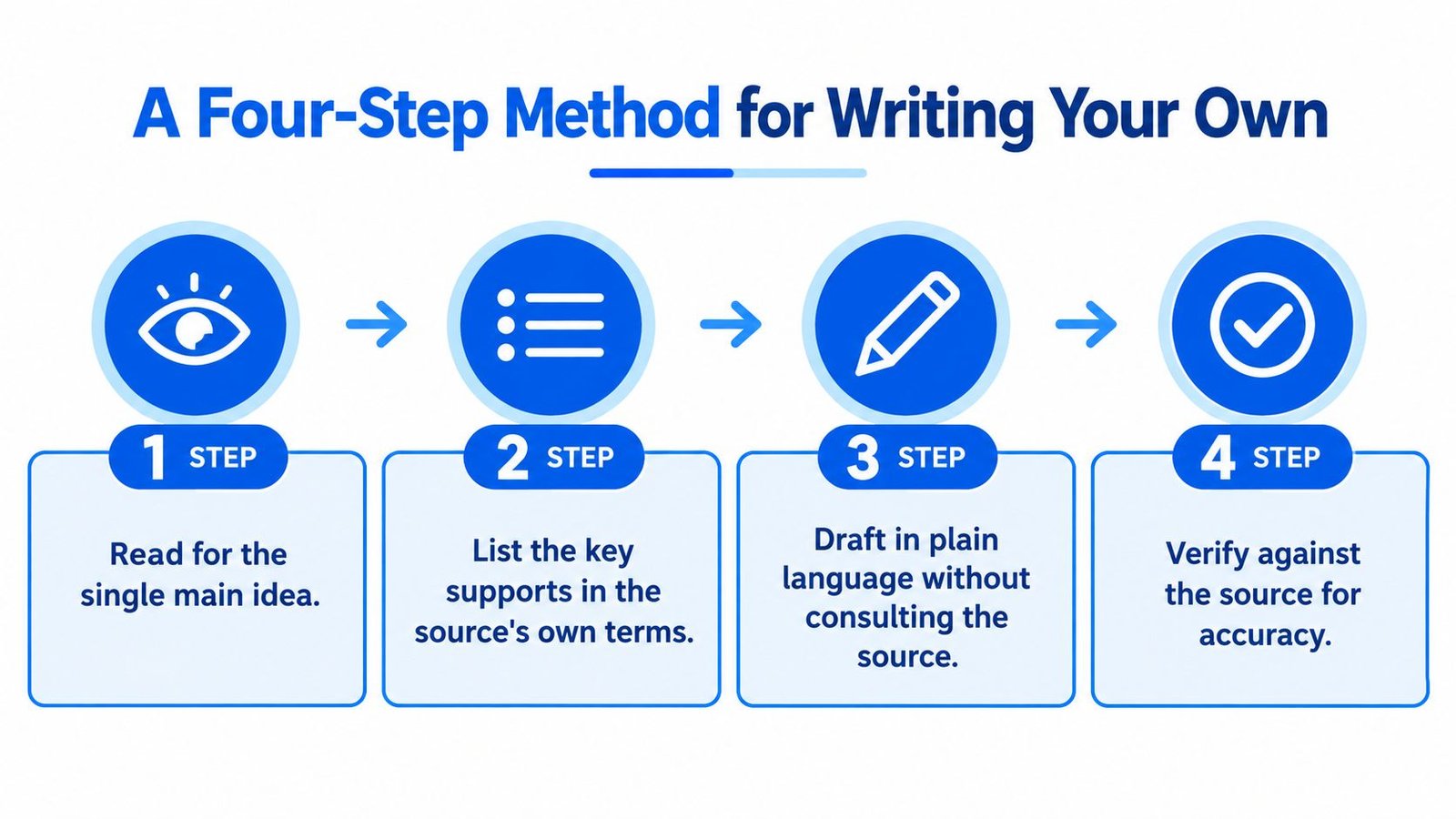
- A Four-Step Method for Writing Your Own
- Do's and Don'ts and Where AI Summaries Fit
- The Three Most Common Traps and How to Avoid Them
- Putting It All Together in One Sentence
A Clear Definition You Can Use Right Now
An objective summary is a neutral, condensed restatement of a source's main idea, written in your own words, with no opinion, emotion, or outside information. This definition reflects the central explanation in guides to objective summaries.
Each part carries a separate responsibility.
Neutral means you report the source's position rather than your own reaction. If the author is cautious, your summary should remain cautious. If the source presents a claim without proving it, you shouldn't make the claim sound certain.
Condensed means shorter, but not empty. Keep the main idea and the supporting points needed to understand it. Remove repeated explanations, minor examples, decorative details, and background that doesn't affect the source's central meaning.
In your own words means you rebuild the idea with fresh vocabulary and sentence patterns. Replacing a few words while keeping the original sentence structure is too close to copying. Read the passage, identify its meaning, look away from it, and then explain that meaning naturally.
No outside information means the summary stays inside the boundaries of the source. You don't add a statistic, example, historical fact, or personal experience just because it seems relevant.
A useful test is whether a reader could compare your summary with the source and recognize the same message without finding your judgment added to it.
Here are four short examples:
- Neutral: “The passage argues that sleep loss lowers test scores.”
- Condensed: “The article connects limited sleep with weaker academic performance.”
- Original wording: “The author links inadequate rest to reduced performance on tests.”
- No outside information: “The passage reports lower test performance after sleep loss,” without adding a cause the passage never mentions.
Objective writing isn't bland writing. It's controlled writing. Your job is to preserve meaning while removing your presence from the report.
Why Objective Summaries Matter Across School, Work, and Accessibility
Students use objective summaries before they respond to a source. A book report needs to show what a chapter says before evaluating it. A research response needs to distinguish the researcher's claim from the student's interpretation. When that boundary is clear, readers can tell which ideas come from the source and which belong to the writer.
The same discipline helps professionals. A meeting recap should record the topic, decisions, and action items without turning one participant's concern into the team's conclusion. A project brief should preserve qualifications and unresolved questions. A case write-up should let someone who wasn't present understand what happened without relying on a note-taker's emotional reaction.
Practical rule: A summary should make the original easier to review, not easier to misrepresent.
Accessibility adds another layer. A reader may need a short version of a lecture, meeting, conversation, or document because of time, attention, language, or cognitive load. An objective summary can support that reader when it preserves the source's essential meaning instead of reducing it to a vague label. For lecture preparation and review, resources on taking notes in lectures can complement, but not replace, careful summarizing.
Live speech creates a related need. RNID explains that speech-to-text apps convert spoken conversation into written text in real time and display it on a phone, making them useful for conversations, lectures, classroom discussions, meetings, and note-taking. Google Accessibility's information on automatic captions says real-time speech-to-text transcriptions can cover over 70 languages and dialects, while automatic captions can work without Wi-Fi or mobile data in supported situations.
The history of machine summarization also shows why this skill reaches beyond school. Hans Peter Luhn's 1958 work is widely cited as an early effort to produce machine-generated summaries by using word-frequency heuristics to identify important sentences, as described in this history of machine summarization. Whether a person or a system writes the summary, the central challenge remains the same: compress information without losing its core meaning.
The Four Traits Every Objective Summary Shares
A strong objective summary has four essential traits. A fifth boundary, no outside information, protects all four.
Neutrality
Neutrality means the summary reflects the source's tone and position. It doesn't praise, attack, dramatize, or strengthen the source's claim. Pay attention to words such as “may,” “could,” “suggests,” and “in some cases.” These qualifiers limit a claim, so removing them can make your summary inaccurate.
From a passage about sleep and test scores:
- Source meaning: Sleep loss may lower test performance.
- Neutral summary: “The passage suggests that reduced sleep may affect test performance.”
- Non-neutral version: “The passage proves that poor sleep causes students to fail.”
The second version adds certainty and a stronger conclusion than the source supports.
Faithfulness
Faithfulness means every included claim matches the source. It also means you don't leave out a qualification that changes the meaning. A summary can be short and still be faithful if each sentence earns its place.
For the same sleep passage:
- Faithful: “The passage links sleep loss with lower test performance and describes findings that support the connection.”
- Unfaithful: “The passage says sleep is the only factor affecting test scores.”
The unfaithful version adds an exclusive claim the source didn't make.
Conciseness
Conciseness means distilling the source to its essential meaning. A useful summary doesn't preserve every example just because the example was memorable. It keeps details that explain, limit, or support the main idea.
- Concise: “The passage connects insufficient sleep with weaker test performance.”
- Overloaded: “The passage discusses bedtime routines, morning habits, classroom lighting, breakfast choices, several student experiences, and the relationship between insufficient sleep and weaker test performance.”
The second sentence may contain details from the source, but it hides the central point.
Original wording
Original wording shows that you understand the source rather than copying it. Change the structure as well as the vocabulary.
- Source-like wording: “Students who experience sleep deprivation demonstrate decreased scores.”
- Original wording: “The passage reports that students perform less well when they don't get enough sleep.”
Use this guide to meeting minutes with action items when you're summarizing spoken content, but apply the same standards of neutrality and accuracy.
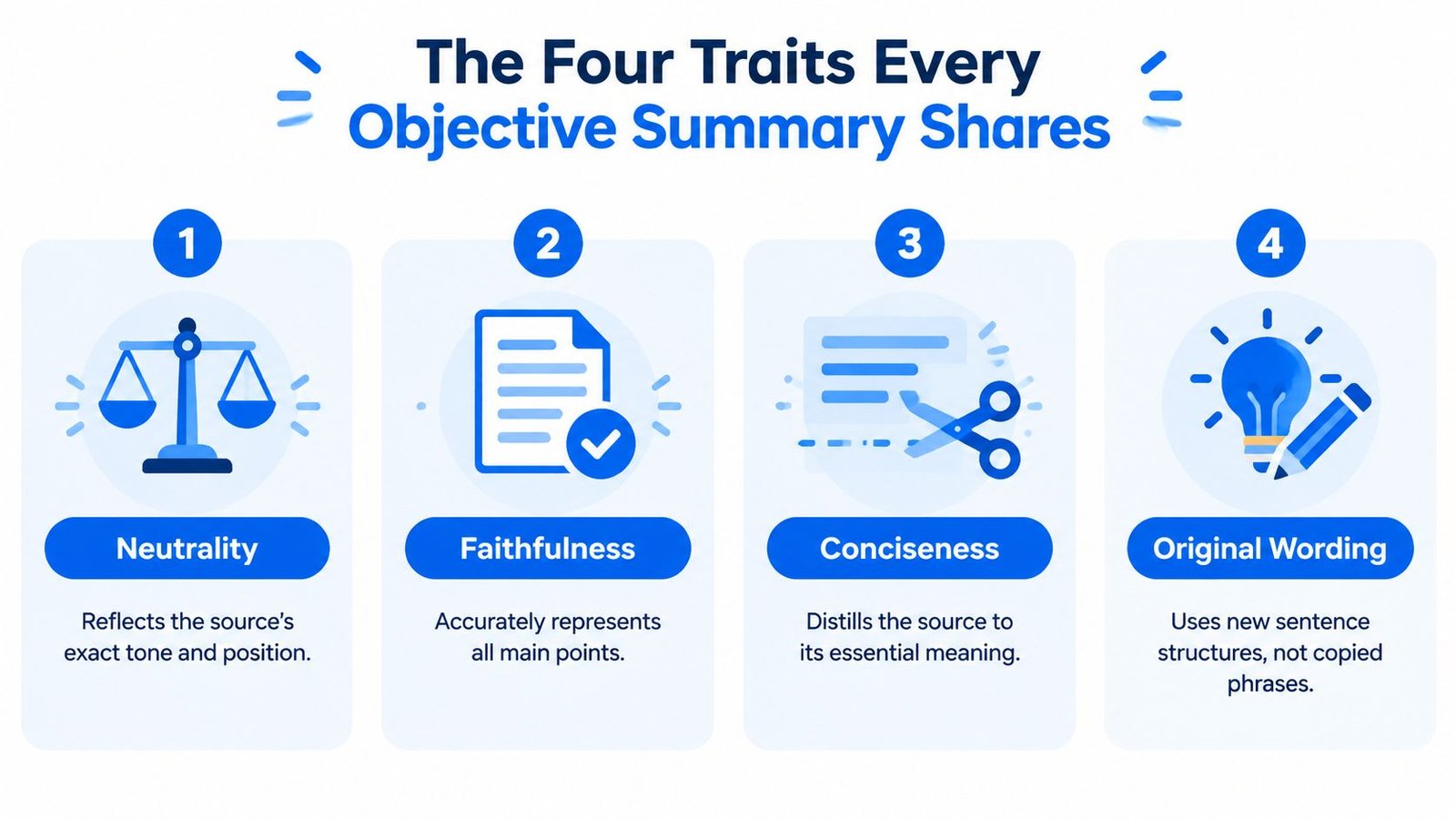
Keep this checklist beside your draft:
- Neutral: Does the tone match the source?
- Faithful: Did you preserve the key claim and qualifiers?
- Concise: Did you remove details that aren't essential?
- Original: Did you write with fresh wording?
- Contained: Did you avoid outside information?
An Objective Summary in Action With a Short Passage
Read this invented practice passage as if it were a short piece of sleep science writing:
Researchers examined how limited sleep affects students preparing for tests. The passage explains that sleep supports attention and memory, two abilities students use when learning and recalling information. It reports that students who slept less showed weaker performance on later tests than students who had more opportunity to rest. The author also describes a finding that sleep loss affected attention during study sessions, making it harder for some students to remain focused on difficult material. The passage doesn't claim that sleep determines every test result. Instead, it presents reduced sleep as one condition associated with poorer performance and emphasizes that the relationship should be interpreted alongside the limits of the research. The author concludes that students and educators should treat sleep as a relevant part of learning conditions rather than as a guarantee of academic success. The passage focuses on the connection between rest, attention, memory, and test performance without recommending a particular schedule or making a universal claim about every student.
First, find the main claim: limited sleep is associated with weaker test performance. That is the spine of the summary.
Next, identify the supports that make the claim understandable. The passage connects sleep with attention and memory, then reports weaker test performance and reduced focus during study. The specific research method and technical terminology would be background unless the assignment asks for them.
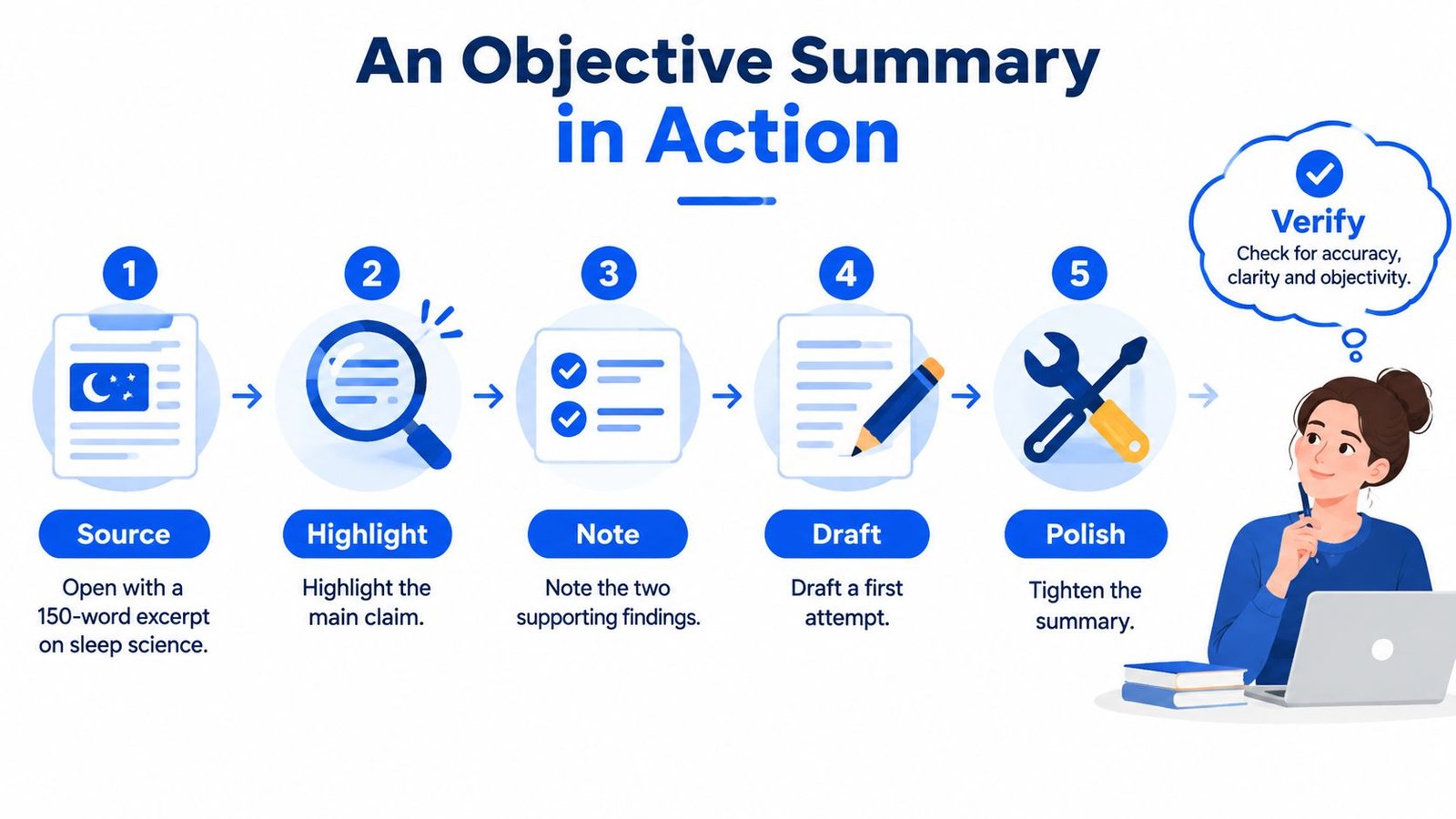
My first draft might read: “The passage says that students who sleep less perform worse because sleep helps attention and memory, and it recommends that students follow a better schedule.” That draft has useful material, but it makes two mistakes. “Because” may overstate the source's evidence, and the passage doesn't recommend a specific schedule.
I would tighten it to this 60-word model summary:
The passage examines the relationship between limited sleep and test performance. It explains that sleep supports attention and memory, then reports that students with less rest showed weaker performance and reduced focus during study. The author presents sleep loss as one factor associated with poorer academic performance, while acknowledging that it doesn't determine every result.
Notice what I cut. I removed the repeated explanation of learning, the extended qualification about research limits, and the final statement about educators because those details aren't necessary for this short model. I also resisted adding “students should prioritize sleep,” even though that sounds sensible. That would be advice from me, not a restatement of the passage.
For readers practicing GCSE English synthesising multiple texts, the same habit applies: identify the shared or central idea, select supporting information, and avoid turning synthesis into personal commentary.
A Four-Step Method for Writing Your Own
A repeatable process keeps summarizing from becoming guesswork.
Step one, read for the single main idea
Read the whole source before drafting. Ask, “What is this source mainly saying?” Write the answer in one rough sentence, without worrying about elegant wording.
For the sleep passage, the note might be: “The passage connects limited sleep with weaker test performance.”
That sentence isn't your final summary. It's a compass. If you can't state the main idea, you're not ready to choose details.
Step two, list the key supports
Write down the points that directly explain or support the central idea. Use short notes rather than copied sentences.
For the practice passage:
- Sleep supports attention and memory.
- Students with less rest showed weaker test performance.
- Sleep loss was associated with reduced focus during study.
- The source doesn't claim sleep determines every result.
The final point matters because it limits the claim. Supporting details aren't always evidence that strengthens the argument. Sometimes they're boundaries that prevent distortion.
Step three, draft in plain language
Look away from the source and write from your notes. This helps you avoid copying and forces you to decide what you understand.
A plain-language draft could be: “The passage links limited sleep with weaker test performance. It explains that rest supports attention and memory and reports lower performance and reduced focus among students with less sleep.”
If you're working from a recording, converting audio files to text can give you searchable material, but a transcript still needs judgment. Spoken repetition, interruptions, and unfinished sentences don't automatically belong in the final summary.
Step four, verify every claim
Compare each sentence with the original. Check the subject, action, strength of the claim, and important limits. Remove anything you assumed rather than found.
For the sleep example, verify that “links” is safer than “proves,” and that “among students with less sleep” doesn't become “among all students.”
Before submitting, spend 90 seconds asking:
Does every sentence state what the source says, and only what the source says, in shorter and clearer language?
If the answer is no, revise the sentence that fails rather than adding more explanation.
Do's and Don'ts and Where AI Summaries Fit
Use the comparison below as a practical editing tool.
Objective Summary Do's and Don'ts
| Do | Don't |
|---|---|
| Stick to the source: Report its central idea and essential supports. | Add personal opinions: Don't write “I agree” or “this is an excellent argument.” |
| Name the author or speaker: Make clear whose ideas you're reporting when the source identifies them. | Drop meaning-changing context: Don't remove a qualification that limits the claim. |
| Keep it short: Remove repetition, minor examples, and decorative details. | Copy phrases: Don't patch together the source's wording and call it paraphrasing. |
| Check facts: Compare your draft with the original before sharing it. | Pad with quotes: Don't use quotations to avoid explaining the idea yourself. |
The author's name helps maintain attribution, but it doesn't turn a summary into an evaluation. “The author connects limited sleep with weaker test performance” reports ownership of the claim. “The author insightfully exposes the serious dangers of sleep loss” adds praise and interpretation.
Accessibility work uses the same distinction. When you create a short description for an image, an alt text generator AI may help produce a first draft, but the writer still needs to check whether the description includes what a reader needs and leaves out distracting interpretation.
AI-generated summaries can condense dense text quickly. They can also organize a transcript into key points or possible action items. Treat the output as a first draft, not a finished summary, because an AI system can hallucinate details, flatten nuance, or miss a qualification.
Speech recognition creates another verification problem. One 2026 source reports median word error rates of around 9% to 19% in controlled conditions and above 50% in noisy real-world conversation, so an AI summary built from imperfect transcription can inherit errors. Those figures are discussed in this report on AI note-taking statistics. For live meetings, lectures, or doctor's offices, verify important names, numbers, decisions, and action items against the recording or transcript.
You can learn more about AI audio transcription apps, but no automated output removes the writer's responsibility to check the source.
The Three Most Common Traps and How to Avoid Them
Students and professionals usually don't fail because they can't shorten text. They fail because shortening changes what the source means.
Three Common Traps in Objective Summaries
| Trap | Warning Sign | Correction Habit |
|---|---|---|
| Opinion creep | Words such as “outrageous,” “surprisingly,” or “unfortunately” appear in the draft. | Circle every evaluative word and remove it unless the source itself used it as part of its reported position. |
| Aggressive compression | The summary sounds simple, but it leaves out a condition or qualification. | Compare the main claim with the supporting context and keep any detail that limits the claim. |
| Unverified AI output | The draft contains polished claims you can't locate in the original. | Check each sentence against the source before submitting or sharing it. |
Here's a small correction for opinion creep:
- Before: “The article unfortunately shows that sleep loss hurts students.”
- After: “The article reports that sleep loss is associated with weaker student performance.”
The second sentence doesn't tell the reader how to feel. It reports the source's point.
Aggressive compression often looks efficient. “Sleep causes poor grades” is shorter than a careful explanation, but it may reverse or strengthen the source's meaning. A better version preserves the relationship and its limits: “The passage connects limited sleep with weaker test performance but doesn't present sleep as the only influence.”
AI verification needs the same patience as human editing. If a generated draft mentions a finding, recommendation, or conclusion that you can't find in the source, delete it or investigate it before using the summary.
Putting It All Together in One Sentence
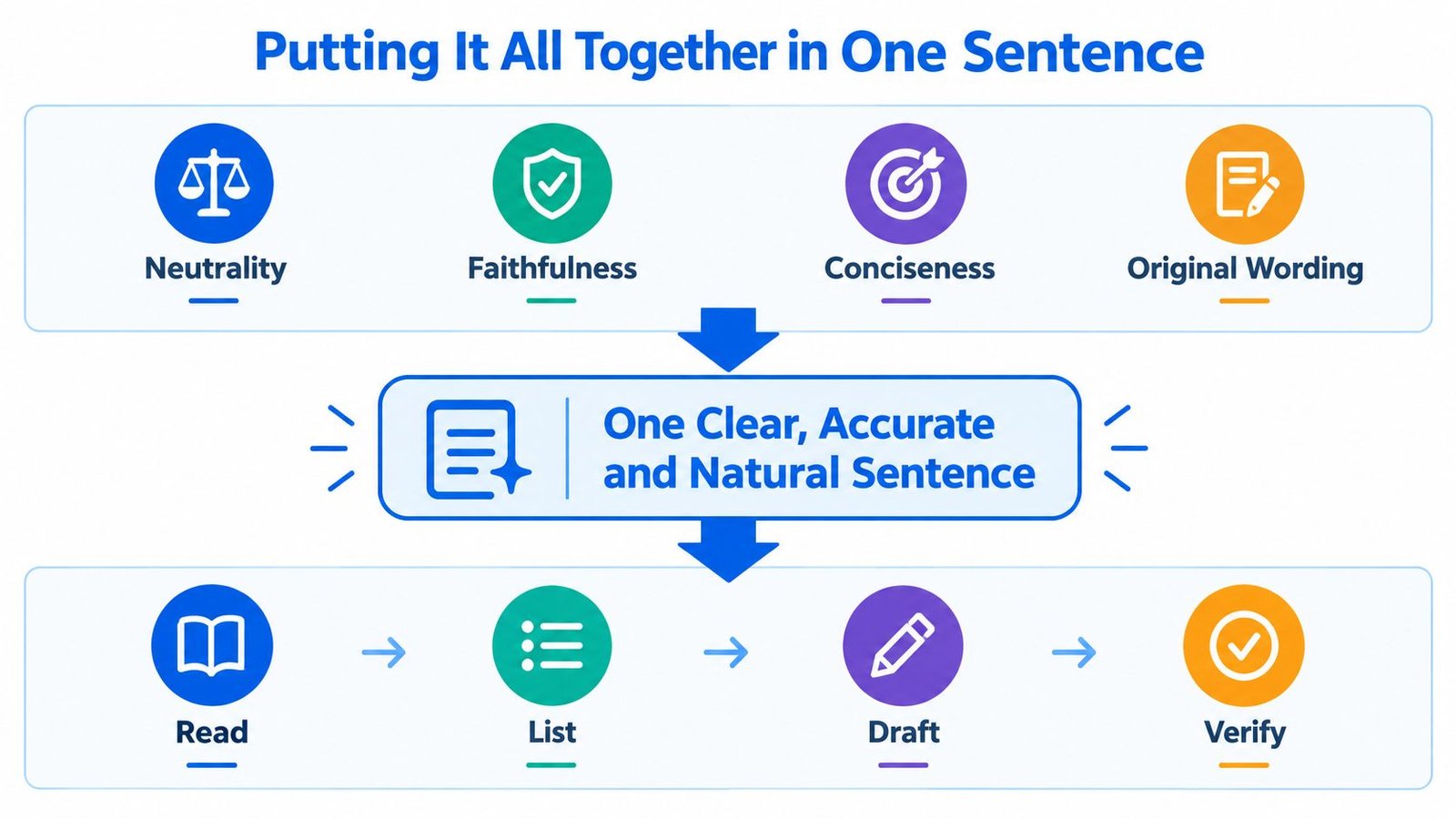
An objective summary is a neutral, faithful, concise restatement in original wording, created by reading for the main idea, listing essential supports, drafting in plain language, and verifying every claim against the source.
That's the sentence to repeat before opening a blank document or using a summarizer. It keeps the purpose and the process together: preserve meaning, remove judgment, shorten carefully, and check your work.
Objective summarizing isn't a pass-fail trick. It's a skill that improves as you practice choosing what matters and noticing what changes meaning. Take a short article today, write one sentence that captures its central idea, and then check whether every word earns its place.
If you need to follow spoken content before turning it into an objective summary, iScribe Live Transcribe offers real-time captions, saved transcripts, and AI-generated summaries for conversations, meetings, lectures, and recordings on iPhone and iPad. Visit iScribe Live Transcribe, review its available features, and use any generated summary as a draft that you verify against the original speech.