

Auditory processing disorder is a problem in how the ears and brain make sense of sound, and a standard hearing test can look normal. That's why someone can hear the words being spoken and still miss what they mean.
You might notice it in a noisy restaurant, a packed meeting, a classroom, a church service, or a doctor's office. The voice is there, but the words blur, split apart, or disappear into the background. If that sounds familiar, the next step is understanding what APD is, what it isn't, and what helps.
Table of Contents
- When Hearing Is Fine but Listening Is Hard
- How the Brain Makes Sense of Sound
- APD vs. Hearing Loss, ADHD, Dyslexia, and Anxiety
- Signs You Might Notice in Real Life
- How APD Is Diagnosed
- Supports That Make Listening Work in Daily Life
- Questions People Ask After a First Diagnosis
When Hearing Is Fine but Listening Is Hard
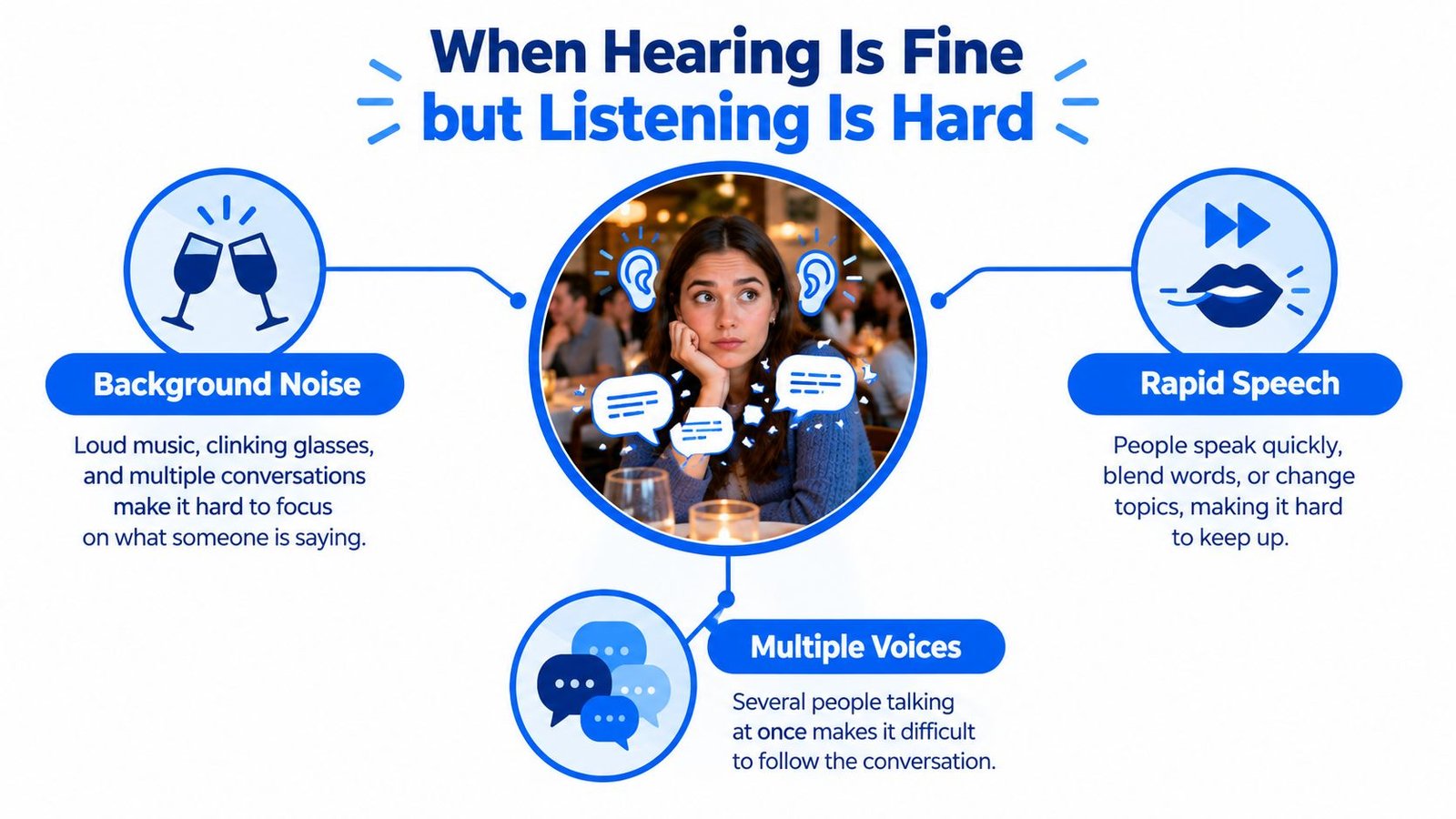
You're sitting across from someone in a busy café, and you can hear the voice clearly enough to know they're talking. The problem is that the sentence won't quite hold together, because the clatter of cups, the music, and the voices nearby keep breaking it apart.
Auditory processing disorder, also called central auditory processing disorder (CAPD), is a difficulty in how the brain handles auditory information, not a problem with hearing sensitivity. The standard hearing test may look normal, yet the person still struggles to interpret spoken language in real settings, especially when the room is loud or the speech comes fast.
What this means in practice
The important point is that APD is about listening, not just hearing. A person may detect sound normally and still struggle to sort speech from competing noise, follow rapid directions, or keep track of who said what.
That's why a normal audiogram doesn't settle the question. It only tells you how well the ear detects sound at certain levels, not how well the brain organizes that sound into language.
Practical rule: if the complaint is “I hear you, but I can't make out what you said,” think beyond hearing sensitivity.
A good next step is to look at the broader pattern, which includes the setting, the type of speech, and the support a person needs to stay oriented. If you want a related overview of captions as a communication aid, this explanation of closed captioning is useful because it shows how visual text can support spoken language.
For readers comparing hearing-related needs more broadly, a resource like compare senior hearing aids can be helpful for understanding one part of the picture, even though APD itself is a different issue. The key takeaway is simple, normal hearing on a test does not erase real listening difficulty.
How the Brain Makes Sense of Sound
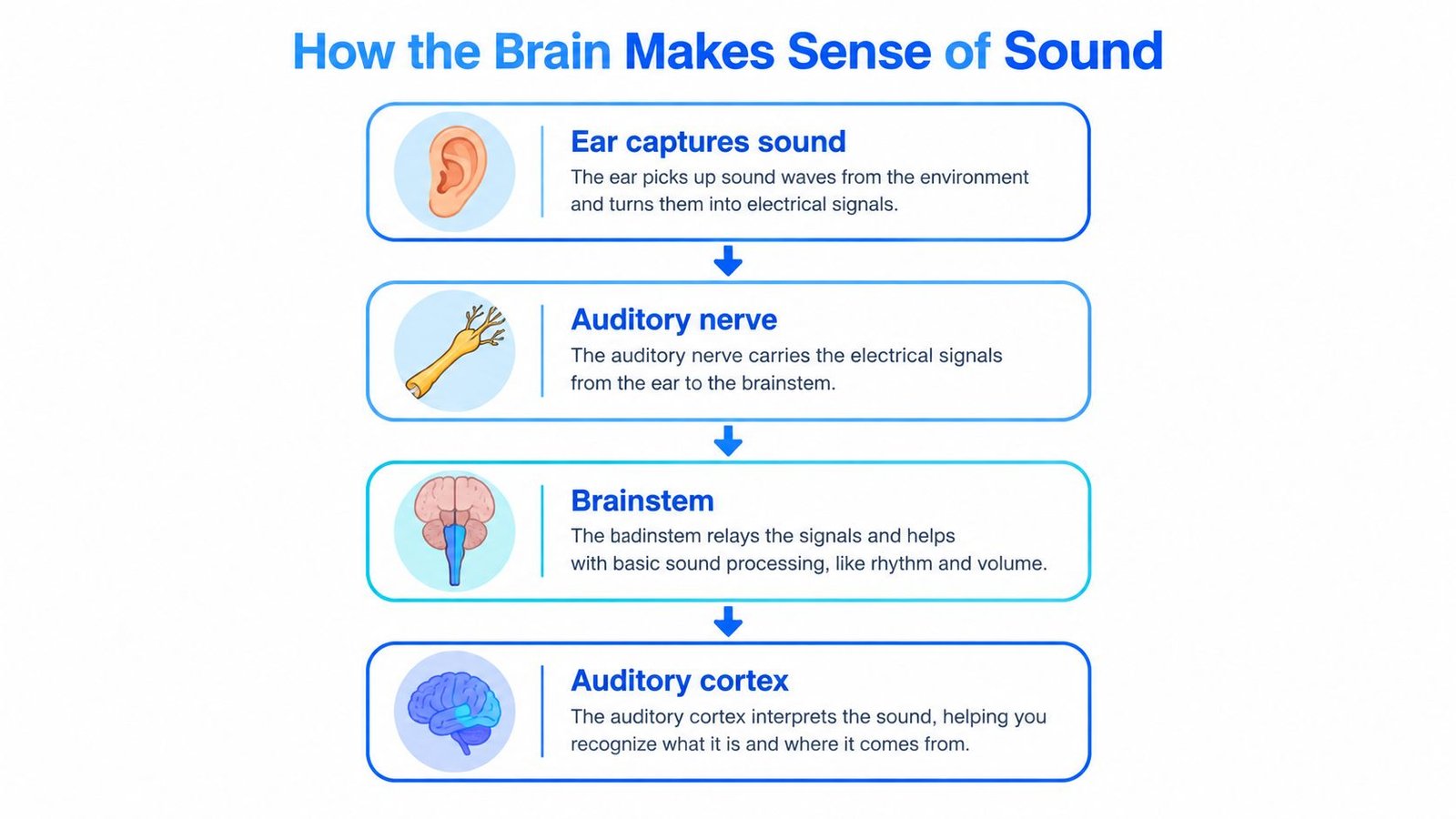
Sound enters through the ear, but listening depends on a whole chain that continues into the central auditory nervous system. That system includes the pathways and brain regions that interpret sound, organize timing, and separate one voice from another.
The skills that can break down
ASHA describes CAPD as impaired neural processing within that central auditory system, and the affected skills can include sound localization and lateralization meaning telling where sound comes from, auditory discrimination meaning telling one sound from another, pattern recognition, temporal resolution and ordering meaning handling timing differences, dichotic listening meaning processing different input to each ear, and understanding degraded or competing speech ASHA CAPD practice portal.
That sounds technical, but the lived version is easier to picture. It's like a studio engineer trying to balance several tracks at once. The microphone is not off. The problem is that the mixing work is harder than it should be.
A person with APD may know that sound is present, but still not be able to cleanly separate the talker from the room. Two people can have similar hearing test results and very different real-world listening experiences because the issue is happening after sound enters the ear.
Why this is a brain skill problem
ASHA's guidance also makes a second point that matters clinically. APD diagnosis requires evidence of impaired auditory neural processing while excluding language, attention, cognition, and related non-auditory explanations that can produce similar complaints ASHA policy statement.
That boundary is important because hearing is only the first step. A person can hear speech and still not process it efficiently enough to use it in the moment. Children Psych's overview of auditory processing disorder in kids is a useful reminder that the same basic idea applies when listening demands rise in school and social settings Children Psych.
Plain version: APD is not “the ears don't work.” It's “the system that makes sense of sound is struggling.”
APD vs. Hearing Loss, ADHD, Dyslexia, and Anxiety
A normal hearing test can be reassuring, but it does not answer every listening question. APD, hearing loss, ADHD, dyslexia, language disorder, and anxiety can all lead to listening complaints, yet each points to a different part of the listening chain.
Listening complaints side by side
| Condition | Main listening complaint | What a hearing test usually shows |
|---|---|---|
| APD | Trouble understanding speech in noise, fast speech, or competing voices | Peripheral hearing may look normal |
| Hearing loss | Sounds may seem muffled, faint, or incomplete | Hearing test often shows reduced sensitivity |
| ADHD | Listening breaks down because attention drifts or competing stimuli take over | Hearing test may be normal |
| Dyslexia | Spoken directions may be hard to hold onto, especially when language processing is taxed | Hearing test may be normal |
| Language disorder | Meaning, vocabulary, or sentence structure can be hard to process | Hearing test may be normal |
| Anxiety | Stress can make spoken information harder to take in and retain | Hearing test may be normal |
Why the boundary matters
The overlap is real, which is why families and adults often mix these conditions up. A person may miss instructions because the room is noisy, because attention slips, because language processing is difficult, or because auditory processing itself is weak. From the outside, the symptom can look the same. The cause is not the same.
That is also why clinical guidance uses audiological, linguistic, cognitive, and behavioral information together rather than relying on a single auditory test. APD is not proven just because someone struggles in noise, and it is not ruled out just because the hearing test is normal, as noted in the diagnostic criteria discussion above PMC review on APD.
The boundary is still debated because auditory skills overlap with attention, language, memory, and cognition. That uncertainty helps explain the wide prevalence estimates reported in school-age children, which range from 0.2% to 6.2%, with one study finding 7.3% to 96% of referred children meeting criteria depending on the protocol and definition used.
If you want a simple takeaway, use this one. APD is one possible explanation, not the only one. The right evaluation has to ask which part of the listening chain is breaking down.
A related overview of listening-related differences in adults and children is available in this hard-of-hearing and deaf comparison, which can help readers separate communication support needs from diagnosis.
Signs You Might Notice in Real Life
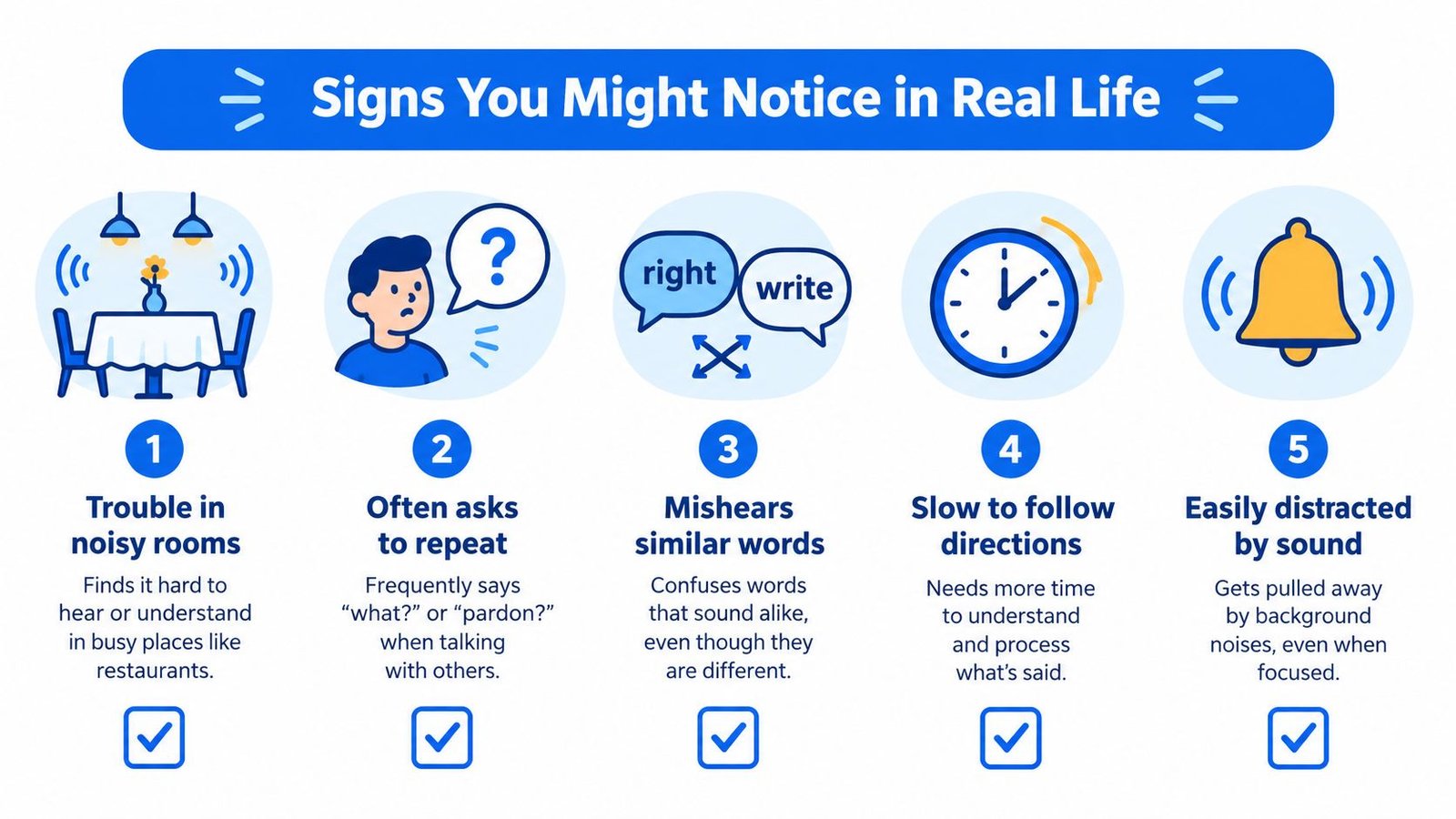
The clearest sign is often not “I can't hear.” It's “I can hear, but I can't keep up.”
Where the difficulty shows up
At school, the problem may appear during a teacher's quick directions, group discussion, or a room full of side conversations. In a workplace meeting, it can show up when several people speak close together or when someone talks while facing a laptop instead of the room. In a family dinner, it may be the same issue, just in a different setting.
The common thread is speech in demanding listening conditions. People with APD may struggle with rapid speech, speech in reverberant rooms, or speech that competes with other voices. They may ask for repetition often, take longer to answer, or give answers that seem inconsistent because part of the message never landed clearly.
The everyday clues people notice
- Trouble in noisy rooms: A restaurant, a coffee shop, or a crowded hallway makes speech harder to pull apart.
- Often asks to repeat: The person is not being careless, they're trying to recover missed words.
- Mishears similar words: Words that sound alike can blur together, especially when speech is fast.
- Slow to follow directions: Multi-step spoken instructions may need to be repeated or written down.
- Easily distracted by sound: Small background noises can compete with the voice that matters.
Other signs can include trouble understanding sarcasm or jokes when meaning depends on tone, trouble locating where sound came from, and difficulty remembering what was said moments earlier. Some people also notice spillover into reading, spelling, or learning because listening pressure makes it harder to build stable language input.
Helpful pattern: if the person does much better in one-on-one quiet conversation than in a noisy room, that contrast is clinically meaningful.
This is also where visual support helps. Continuous captions and written notes give the listener another route to the words, which can reduce the strain of trying to hold every sentence in auditory memory. For students, a guide on taking notes in lectures can be useful because it shows how written support and spoken teaching can work together.
How APD Is Diagnosed
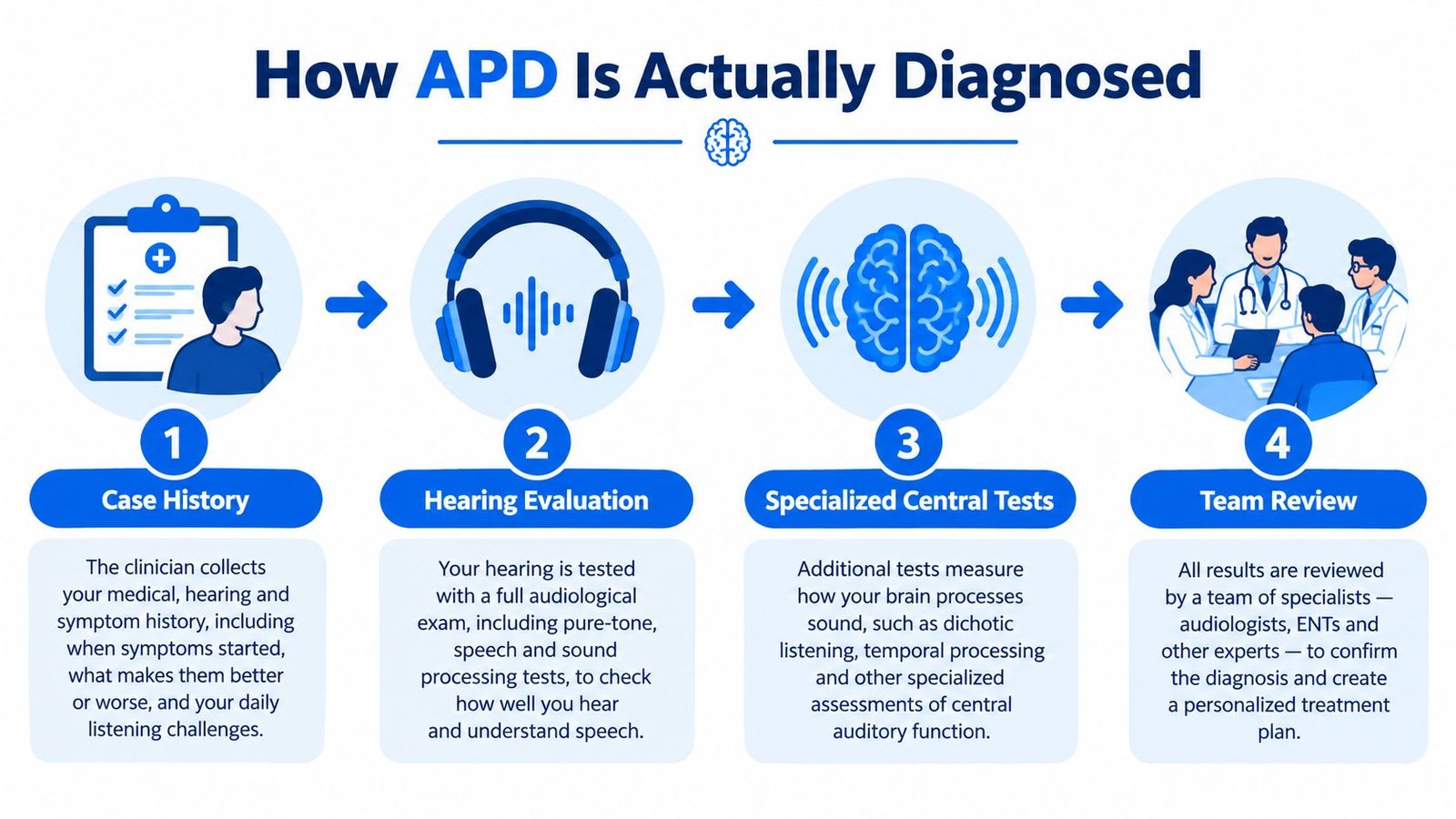
APD is not diagnosed from one quick screen. Clinicians usually combine case history, hearing evaluation, and specialized auditory testing, because current guidance does not rely on a single universal protocol.
What the appointment usually involves
The first part is usually a detailed history. Clinicians ask where listening breaks down, what makes it easier or harder, and whether there have been prior concerns about language, learning, attention, or hearing.
A hearing evaluation comes next, because peripheral hearing has to be checked before anyone can interpret a brain-based listening problem. After that, specialized central auditory tests examine skills APD can affect, such as processing competing speech, timing cues, or distorted speech.
The process often involves more than one professional. An audiologist, a speech-language pathologist, a psychologist, and input from teachers or family members can all help, since the diagnosis has to match real-world function, not only a test score. For a plain-language overview of how clinicians approach this process, auditory processing insights from Orange Neurosciences can help readers follow the logic without turning the label into the whole story.
What to ask and what to watch for
Screening questionnaires can flag risk, but they cannot diagnose APD. A full workup helps separate auditory processing difficulty from language-based, attentional, or emotional explanations.
Practical question to bring: “What else could explain the listening problem, and how do we tell the difference?”
The most useful report does more than name the condition. It explains what the person can do, what breaks down under pressure, and which supports are likely to help in daily life.
Supports That Make Listening Work in Daily Life
The goal is not to force the brain to work like everyone else's. The goal is to make communication usable again.
What usually helps
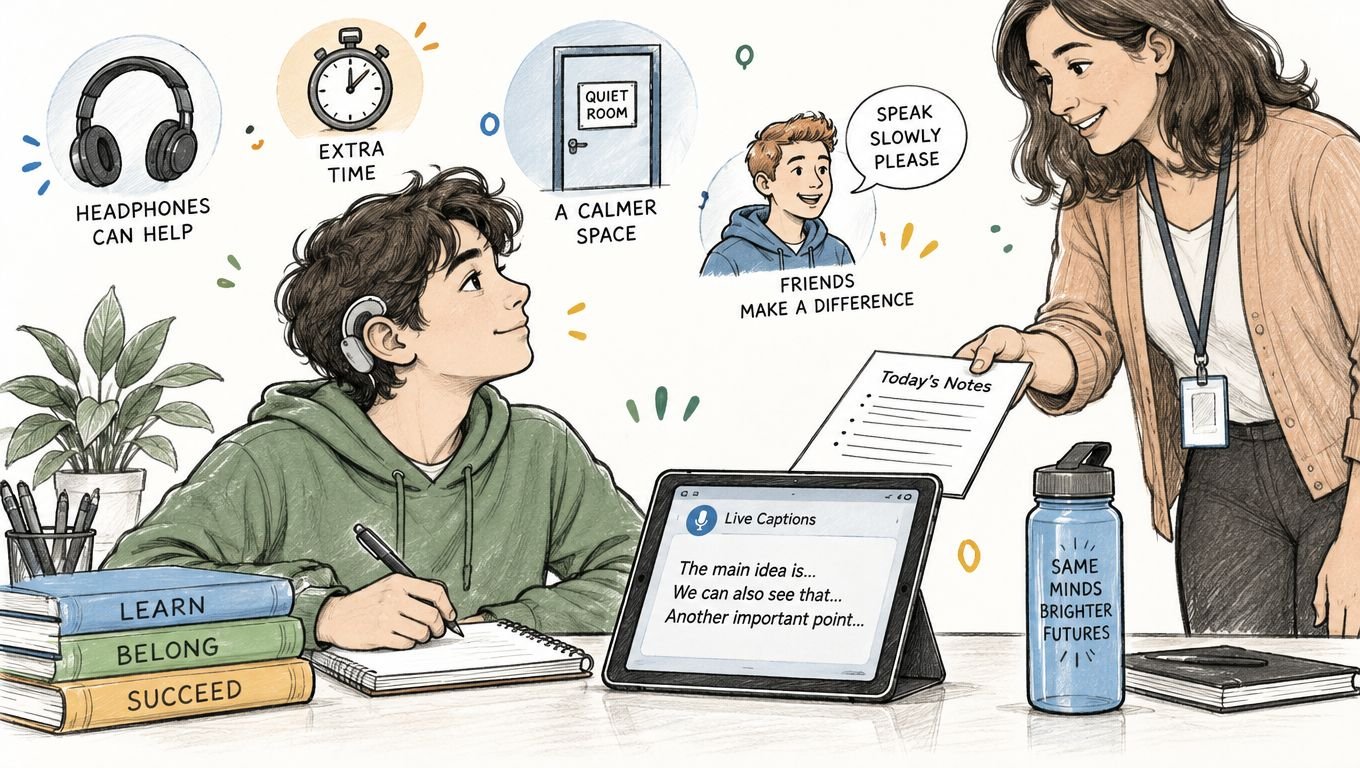
Clinical support can include therapy or strategy work, but daily listening also improves when the environment changes. Quieter rooms, face-to-face communication, shorter spoken directions, and written follow-up all reduce the load on the auditory system.
School and workplace accommodations matter because APD often shows up when speech has to compete with noise. A written agenda, a clear summary after a meeting, or a teacher who posts key instructions can turn a vague listening problem into something workable.
Where captions fit
Real-time captions and transcripts are functional communication supports, not medical treatment. They give the listener a visual path to the words, which helps when speech is fast, noisy, or hard to separate from other voices.
The iScribe app by Harshva Technologies Private Limited is one example of that type of support. Its App Store listing, Live Transcribe iSrcribe, describes a way to see what's being said on iPhone and iPad, which fits naturally in conversations, meetings, classes, and religious services.
If you're choosing supports, think in layers. Use listening strategies first, add environmental changes, then bring in captions or written transcripts when spoken language still isn't reliable. A broader guide to assistive technology for deaf and hard of hearing people can help frame captions as one part of a larger accessibility plan.
Questions People Ask After a First Diagnosis
A normal hearing test does not rule out APD, because APD is about how sound is processed after it's heard. That's why the next step is usually a fuller evaluation, not a reassurance and stop.
APD can show up in childhood or adulthood, and it may be noticed first when listening demands get higher. It isn't the same in every person, because the condition can affect different auditory skills in different ways.
APD is not the same as deafness, and it doesn't mean low intelligence. Some people improve with support and better listening environments, while others continue to need accommodations over time.
If you're asking whether APD is permanent, the honest answer is that the label doesn't tell the whole story. Function can improve when the right supports reduce the strain on listening.
If spoken words are harder to follow in noise, meetings, classes, or church, iScribe Live Transcribe gives you a visual way to keep up with the conversation. It can help turn missed words into readable text, which is exactly why it belongs in the APD conversation. Visit iScribe Live Transcribe to see how live captions and saved transcripts can fit into your daily communication.