 Skip to content


The Complete Lip Reading Guide: How to Learn Speechreading Step by Step
Imagine being in a room full of people and still feeling completely alone because you can’t follow the conversation. For millions of people living with hearing loss – whether mild, severe, or profound – this is an everyday reality.
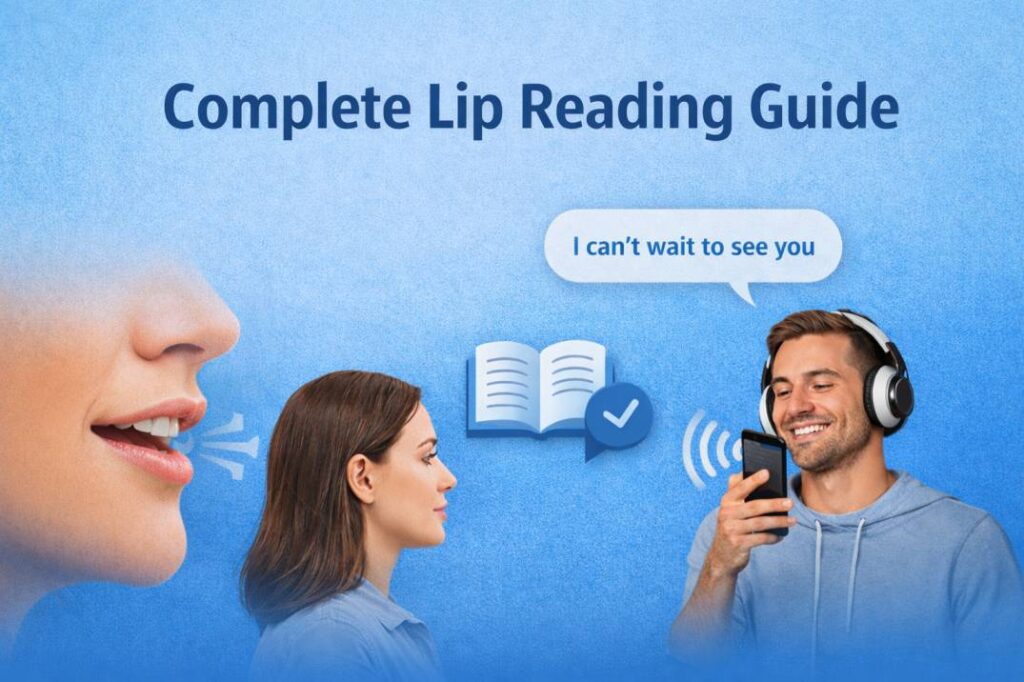
Lip reading, also called speechreading, is one of the most powerful tools available to bridge that gap. It allows people to understand speech by reading the visual cues from a speaker’s face, lips, and expressions – with or without residual hearing.
- Written by: karishma Rautela
- Review by: Mahipal Dosad
Whether you’re newly diagnosed with hearing loss, a parent of a deaf child, or simply someone curious about how to lip read, this complete guide covers everything you need to know-
What Is Lip Reading?
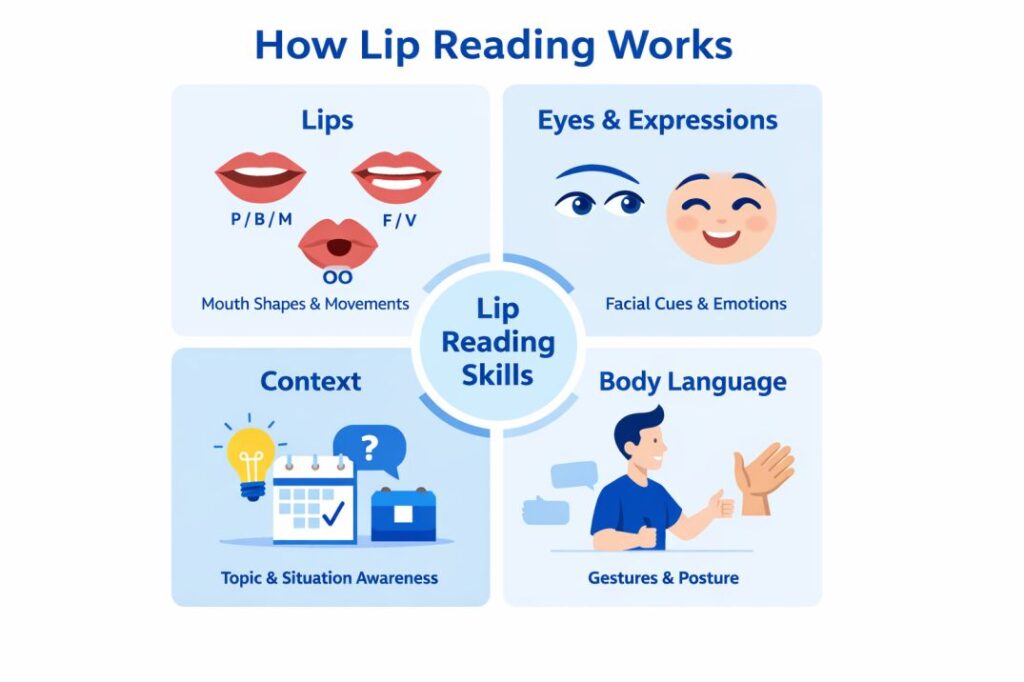
Lip reading – or speechreading – is the skill of interpreting spoken language by watching a speaker’s face. It involves reading:
- Lip and mouth movements
- Facial expressions and eye contact
- Jaw and tongue positioning
- Body language and gestures
The term “speechreading” is actually more precise than “lip reading” because it reflects how the whole face – not just the mouth – contributes to understanding speech. Many organisations and lip reading teachers use both terms interchangeably, but speechreading captures the full picture more accurately.
People who are deaf, hard of hearing, or hearing impaired use lip reading as either a primary or supplementary communication method. It is commonly used alongside hearing aids, cochlear implants, British Sign Language (BSL), or cued speech – giving people flexibility in how they communicate depending on the situation.
How Accurate Is Lip Reading?
This is the question almost every beginner asks – and the honest answer might surprise you.
Lip reading, when used on its own, is only around 30 to 40 percent accurate. Here is why that number is so low even for skilled lip readers:
- Many sounds look completely identical on the lips. Words like “bat,” “mat,” and “pat” are visually indistinguishable – these are called homophones, and English has hundreds of them.
- A significant number of sounds are produced inside the mouth – teeth, tongue, and throat – where they simply cannot be seen from the outside.
- Speed, accents, lighting conditions, and speaker habits all affect how much can be understood visually.
The remaining gap is filled by context clues, prior knowledge, facial expressions, and educated guessing. This is why lip reading works far better in familiar situations with familiar speakers than in unpredictable environments.
Lip reading is most effective when combined with:
- Residual hearing, even if partial
- Contextual awareness – knowing the topic of conversation in advance
- Familiarity with the speaker’s patterns and speech style
- Good lighting and close, direct positioning
So is lip reading real and useful? Absolutely. But it works best as one layer in a broader communication toolkit rather than as a standalone strategy expected to catch everything.
Read complete guide – Communication strategies for people with hearing loss
Can Deaf People Lip Read?
Yes – many deaf people lip read, but it is neither automatic nor universal. Whether lip reading comes naturally or requires significant effort depends on several factors:
- When deafness occurred: People who were born hearing and later experienced hearing loss often find lip reading easier because they already understand how spoken language works and what words are supposed to sound like.
- Training and instruction: Lip reading is a skill, not an instinct. Formal classes and structured practice make an enormous difference.
- Individual differences: Some people pick up visual cues faster than others. This varies just as much as any other learned ability.
For people who were born deaf, lip reading can absolutely still be learned – but it requires patient, structured teaching and realistic expectations about what it can achieve on its own. Many deaf people use lip reading alongside BSL or other communication methods rather than relying on it as their only approach.
How to Lip Read: A Step-by-Step Approach for Beginners
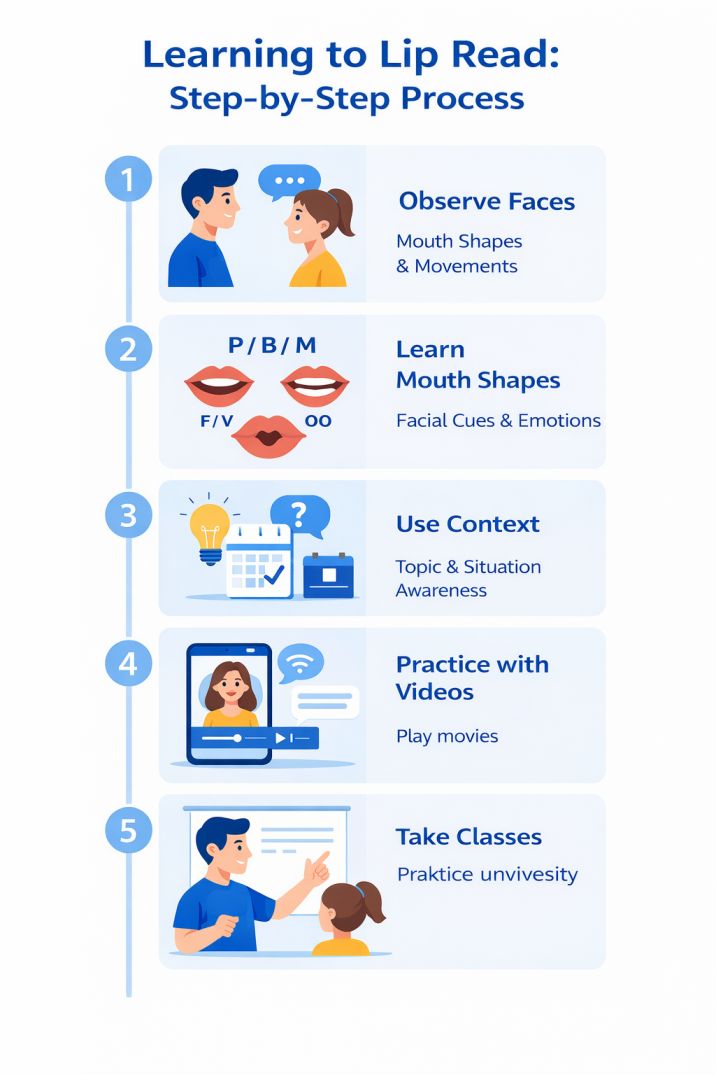
Learning to lip read is a gradual process. There is no shortcut, but there is a sensible progression that makes the journey manageable. Here is a practical framework anyone can start with:
Step 1 – Build Visual Awareness First
Before you can read lips effectively, you need to train your eyes to notice detail quickly. Start by watching people’s faces closely during everyday conversations – even with sound. Pay attention to how different sounds and words shape the mouth. This builds the visual foundation everything else sits on.
Step 2 – Learn the Most Common Mouth Shapes
Not all sounds are equally readable. Focus on the ones that produce the most distinctive visual shapes first:
- Vowel sounds – tend to produce open, rounded mouth positions
- Bilabial sounds (p, b, m) – both lips press together clearly
- Labiodental sounds (f, v) – upper teeth touch the lower lip visibly
Once you recognise these anchors reliably, filling in other sounds becomes easier through context.
Step 3 – Use Context as Your Best Tool
Experienced lip readers do not try to catch every single word. Instead, they focus on key words and let context do the heavy lifting. If you are at a pharmacy, words like “dosage,” “prescription,” and “side effects” are far more likely than random vocabulary. Use that knowledge. Go into conversations with a sense of the topic, and your brain fills in gaps far more efficiently.
Step 4 – Practice Regularly With Videos
One of the most practical ways to practise lip reading for free is by watching video content with the sound turned off. Try:
- News broadcasts – clear speech, well-lit faces, natural pace
- YouTube videos in familiar topics where you already know the vocabulary
- Dedicated lip reading practice websites that offer structured exercises
Start with short clips and gradually increase length as your stamina builds.
Step 5 – Take a Formal Lip Reading Course
Self-practice builds awareness, but working with a qualified lip reading teacher accelerates progress in ways that are very difficult to replicate alone. A good teacher gives you structured feedback, corrects habits early, and introduces exercises designed specifically to build both accuracy and confidence.
Lip Reading Classes and Courses: Where to Learn
Finding the right learning environment matters enormously. Here are the main routes available:
In-Person Lip Reading Classes
Searching for lip reading classes near you is a great starting point. Look through:
- Local deaf charities and hearing loss organisations
- Community education providers and adult learning centres
- Hospitals and audiology departments, which sometimes run or recommend classes
In the UK, the Association of Teachers of Lipreading to Adults (ATLA) trains and accredits qualified lipreading teachers and is the best starting point for finding certified instruction near you. Group classes are particularly valuable because they simulate the real-world experience of following conversation with multiple speakers.
Online Lip Reading Courses
Online learning has made speechreading far more accessible than it once was. A structured online lip reading course offers:
- Learn at your own pace, revisiting lessons as many times as needed
- Access from anywhere – no travel required
- Often more affordable than in-person instruction
- Video-based demonstrations you can rewatch and study closely
Some platforms also offer live online lip reading lessons with qualified tutors via video call, combining the flexibility of online learning with real-time feedback.
Lip Reading Websites and Practice Tools
Several dedicated lip reading websites offer free or low-cost resources, including exercises sorted by difficulty, video-based practice modules, and progress tracking. These are excellent supplements to formal instruction rather than replacements for it.
Practical Tips for Better Lip Reading Every Day
Lip reading is a two-way process. The speaker plays just as important a role as the person lip reading. Here is what helps on both sides:
If you are lip reading:
- Position yourself directly facing the speaker – angle matters significantly
- Make sure the speaker’s face is well lit – avoid situations where light is behind them
- Ask speakers to rephrase rather than simply repeat – different words often land better
- Reduce background noise wherever possible before starting a conversation
- Take breaks during long conversations – fatigue affects accuracy more than most people realise
If you are speaking to someone who lip reads:
- Speak clearly and at a natural, unhurried pace – exaggerating mouth movements actually distorts lip patterns and makes things harder
- Maintain comfortable eye contact throughout
- Keep your face fully visible – do not cover your mouth, look away, or speak while eating
- Be willing to rephrase things patiently rather than repeating the same words louder
- In group settings, signal who is about to speak so the lip reader can shift their focus in time
Lip Reading for Children: What Parents and Educators Need to Know
For families with deaf or hard-of-hearing children, lip reading is often part of a broader communication plan rather than a standalone approach. The National Deaf Children’s Society (NDCS) recommends that lip reading should not be a child’s only method of communication – it works best as one element within a wider strategy that might include BSL, spoken language support, and hearing technology.
Key points for parents:
- Children can absolutely learn to lip read, but it requires appropriate instruction and time
- Schools and educators play a vital role – good lighting, front-row seating, and clear face visibility make a real difference in the classroom
- Avoid placing pressure on children to lip read their way through every situation – it leads to exhaustion and anxiety
- Review communication strategies regularly with the support of a qualified specialist as the child grows and their needs change
Lip Reading Isn't a Complete Solution
Let’s be honest about something that does not get said enough in most lip reading guides.
Lip reading is an incredible skill. It opens doors, builds confidence, and gives people with hearing loss a genuine way to engage in the hearing world. But it was never designed to carry the entire weight of communication on its own – and expecting it to do so puts an unfair burden on the person lip reading.
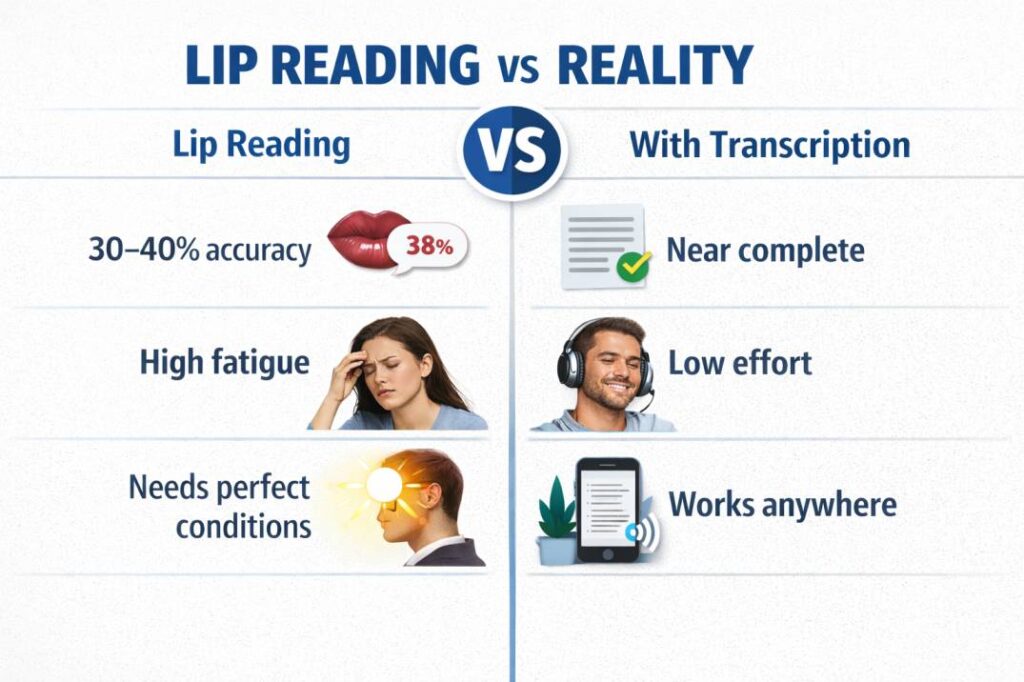
Even the most experienced lip reader is only catching around 30 to 40 percent of what is being said from lip movements alone. The rest is filled in through context, guesswork, facial expressions, and sheer mental effort. That gap is real, and pretending it does not exist does not help anyone.
There are situations where lip reading simply struggles, regardless of skill level:
- Group conversations where speakers change quickly and unpredictably
- Video calls with poor lighting or low-quality cameras
- Noisy environments like restaurants, public transport, or open-plan offices
- Speakers with heavy beards, strong accents, or very fast speech
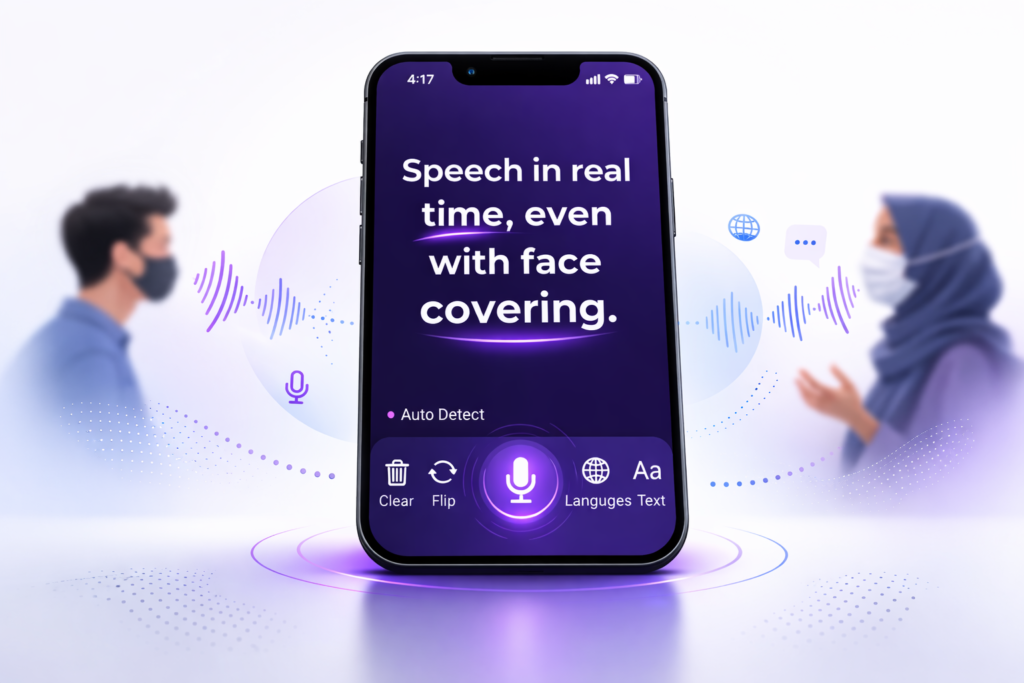
- Mask-wearing – a challenge the deaf and hard-of-hearing community felt sharply during the pandemic and continues to navigate
Mental fatigue is something most hearing people never fully appreciate. Lip reading for hours – in meetings, classrooms, or social settings – is genuinely exhausting in a way that is difficult to explain unless you have experienced it. It requires sustained, intense concentration that drains cognitive energy fast.
So what fills the gap?
Where Technology Steps In:
This is where apps like iScribe become genuinely life-changing – not as a replacement for lip reading, but as a reliable partner sitting alongside it.
iScribe is a live transcription app designed specifically with deaf and hard-of-hearing people in mind. It works by converting spoken words into real-time text on your screen – almost instantly – so you can follow a conversation without depending solely on what you can read from someone’s lips.
What sets iScribe apart from generic voice-to-text tools is that it was built with real accessibility needs at its core. It is not an afterthought feature tacked onto a productivity app. Accessibility is the entire point.
Here is how it fits naturally into daily life alongside lip reading:
- In meetings: Follow the conversation on your phone or tablet while still watching the speaker’s face. If you miss a word or two visually, the live transcript catches it without interrupting the flow.
- At appointments: Medical, legal, or financial conversations carry high stakes – you cannot afford to miss key details. iScribe gives you a real-time written record of what was actually said, removing the anxiety of nodding along and hoping you caught it correctly.
- One-on-one conversations: Even in quieter, more controlled settings, having a live transcript running reduces cognitive load significantly – letting you relax into the conversation rather than concentrating at full intensity throughout.
- Noisy or busy environments: Where lip reading becomes difficult or near impossible, iScribe continues working reliably, covering exactly the situations where visual communication is hardest.
The combination of lip reading and live transcription is powerful precisely because the two approaches cover each other’s weaknesses. Lip reading keeps you visually connected to the person speaking – reading their emotion, tone, and intent. iScribe makes sure the actual words do not slip through the cracks.
A More Honest Approach to Communication
The goal was never to make lip reading do everything. The goal is confident, comfortable communication – and that looks different for everyone.
Some people lip read alongside BSL. Some combine speechreading with hearing aids. Some use live transcription apps like iScribe as a daily tool. Many use a flexible mix depending on the situation, the environment, and the people they are with.
There is no prize for getting through a difficult conversation using lip reading alone when a better solution is sitting in your pocket. Using the right tool at the right time is not a sign of weakness – it is smart communication.
If you have not explored live transcription yet, iScribe is a genuinely worthwhile place to start. It is straightforward to use, designed with the deaf and hard-of-hearing community in mind, and works in real time without making the experience feel clinical or awkward.
Lip reading gives you the skill. Tools like iScribe give you the backup. Together, they give you something far more valuable – the confidence to show up fully in any conversation, any setting, any day.
Expert Tips: Getting More From Speechreading Over Time
A few insights that go beyond the basics and make a lasting difference:
- Fatigue management is a skill in itself. Plan rest breaks into long days. Let people know when you need a moment. This is not a limitation – it is self-awareness.
- Group settings require different strategies. Ask for meeting agendas or written notes in advance so you know what topics are coming. Request that speakers identify themselves before speaking. Use iScribe in parallel to reduce the cognitive load of tracking multiple voices.
- Masks remain a real issue. Clear face masks are available and widely recommended in healthcare, education, and professional settings. If you need one, asking for it is entirely reasonable.
- Technology and lip reading are not in competition. Real-time captioning apps, hearing loops, and note-taking support all work alongside lip reading – not against it. Use everything available to you.
Conclusion
Lip reading is a powerful, learnable skill that can genuinely transform how people with hearing loss communicate and engage with the world. With practice, patience, and the right instruction, it becomes a real asset.
But the most effective communicators are not those who rely on lip reading alone. They are the ones who combine speechreading with tools, strategies, and technology – using each one where it works best.
Your key takeaways:
- Lip reading works best as one part of a broader communication approach, not as a standalone solution
- Accuracy from lip movements alone averages 30 to 40 percent – context, technology, and practice close that gap
- Formal lip reading classes or a structured online course will accelerate progress far faster than self-study alone
- Both the lip reader and the speaker share responsibility for making communication work
- Live transcription apps like iScribe fill the gaps that even skilled lip reading cannot cover – especially in noisy, fast-moving, or high-stakes situations
- Children and adults alike benefit from learning, with appropriate support and realistic expectations
Whether you are searching for lip reading classes near you, exploring online lip reading courses, or just beginning to understand what speechreading involves – the best first step is simply starting. And once you do, build around that skill with every tool available to you.
Frequently Asked Questions
What is lip reading and how does it work?
Lip reading, also known as speechreading, is the skill of understanding speech by visually interpreting a speaker’s lip movements, facial expressions, and body language. It works best when combined with residual hearing, contextual awareness, and supporting tools like live transcription apps.
How accurate is lip reading?
Lip reading alone is typically around 30 to 40 percent accurate because many sounds look identical on the lips. Accuracy improves significantly when combined with context clues, familiarity with the speaker, and technology such as real-time transcription.
Can deaf people lip read?
Yes, many deaf people lip read – though ability varies. Those who became deaf after learning spoken language often find it easier to pick up. Formal training helps all learners improve meaningfully, and lip reading is most effective when combined with other communication strategies.
How can I learn to lip read on my own?
You can start by building visual awareness, learning common mouth shapes, using context clues, and practising with muted video content. However, a formal lip reading class or structured online lip reading course will help you progress significantly faster and avoid common habits that hold learners back.
Where can I find lip reading classes near me?
In the US, you can find lip reading classes through the Hearing Loss Association of America (HLAA) at hlaa.org, which lists local chapters across all states that run or recommend speechreading programs. Your audiologist, local community college, or nearby deaf and hard-of-hearing center are also great places to ask. If nothing is available near you, online lip reading courses are a solid alternative that you can access from anywhere.
What is iScribe and how does it help lip readers?
iScribe is a live transcription app that converts speech into real-time text on screen. It is designed with deaf and hard-of-hearing users in mind and works as a practical companion to lip reading – filling in the gaps during meetings, appointments, noisy environments, and group conversations where lip reading alone is not enough.