

Deaf History Month 2026: Dates, Key Facts & How to Celebrate
Every April, the United States pauses to honor a community that has shaped language, education, civil rights, and culture in ways most people never learned in school.
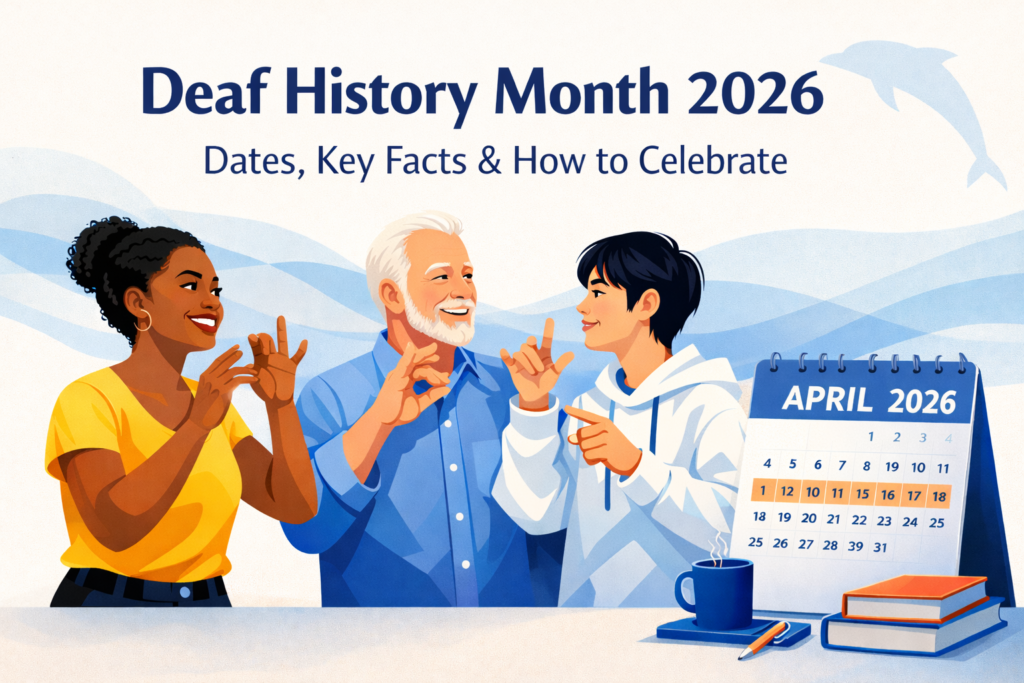
Deaf History Month 2026 runs from April 1 through April 30. It is a time to recognize the achievements of deaf and hard of hearing individuals, learn about the milestones that changed their lives, and take real steps toward a more inclusive world.
Whether you are deaf, hard of hearing, a caregiver, a student, or simply curious – this guide covers everything you need to know. You will learn when and why this month started, the three landmark dates behind it, the famous deaf figures worth knowing, and practical ways to participate.
- Written by: Karishma Rautela
- Review by: Mahipal Dosad
What Is Deaf History Month?
National Deaf History Month is an annual observance in the United States dedicated to celebrating the contributions, history, and culture of the deaf and hard of hearing community.
It is not a federal holiday, but it is widely recognized by libraries, schools, government agencies, and advocacy organizations across the country.
The month shines a light on:
- The history of deaf education in America
- Civil rights milestones won by the deaf community
- Famous deaf and hard of hearing individuals who changed the world
- The ongoing challenges faced by those with hearing loss
- The richness of Deaf culture, including American Sign Language (ASL)
When Is Deaf History Month 2026?
Deaf History Month 2026 is celebrated from April 1 through April 30.
This is a question many people search for every year – and the answer has actually changed over time. Here is the short version:
The original dates were March 13 to April 15, chosen to anchor the observance to three specific milestones in deaf history. In 2022, the National Association of the Deaf (NAD) officially moved the observance to the full month of April 1–30. The reason was intentional: the shift was made to broaden the celebration to include the experiences of BIPOC Deaf people and dismantle a narrower, school-focused historical lens.
So if you are wondering about deaf history month 2025, 2024, 2023, or any recent year – the answer is the same: the full month of April, per the NAD’s current guidance.
Some organizations and libraries still reference March 13 to April 15, which is why you may see both timeframes online.
What Are the 3 Dates of Deaf History Month?
The original March 13–April 15 timeframe was built around three cornerstone events in American deaf history. These dates still matter deeply, even under the updated April 1–30 observance.
April 15, 1817 – The American School for the Deaf Opens
On this date, the first public school for the deaf in the United States opened in Hartford, Connecticut. It was founded by Thomas Hopkins Gallaudet, Mason Cogswell, and Laurent Clerc. It was also the first school in the entire Western Hemisphere dedicated to educating any student with a disability. Teachers trained there went on to establish deaf schools across the country.
April 8, 1864 – Gallaudet University Is Founded
President Abraham Lincoln signed the charter for Gallaudet University on this date, making it the first institution of higher learning for deaf and hard of hearing students in the world. It remains the only university where all programs are designed for deaf and hard of hearing students, with instruction delivered in both ASL and English.
March 13, 1988 – The Deaf President Now Movement
This is perhaps the most powerful date in modern deaf history. In early March 1988, Gallaudet’s board of trustees selected a hearing candidate as the university’s new president – passing over two highly qualified deaf candidates. Students responded by chaining the campus gates shut and refusing to back down. The protest became known as the “Deaf President Now” movement. The board reversed its decision, and I. King Jordan was appointed as Gallaudet’s first deaf president. The movement became a catalyst for the Americans with Disabilities Act.
When Did Deaf History Month Start?
The story begins not with a national campaign, but with two employees at a library.
In 1996, two deaf staff members at the Martin Luther King Jr. Memorial Library in Washington, D.C. marked the anniversary of the Deaf President Now movement by teaching their hearing coworkers American Sign Language. That small gesture sparked something larger. The library’s management – led by Alice Hagemeyer, America’s first deaf librarian – used it as inspiration to create Deaf Awareness Week.
From there, the National Association of the Deaf proposed a full month-long observance. The first nationwide Deaf History Month was celebrated in 1997. In 2006, the American Library Association (ALA) formally partnered with the NAD to promote the observance. In 2022, the NAD moved the dates to April 1–30 to make the celebration more inclusive.
Famous Deaf and Hard of Hearing People Worth Knowing
One of the richest parts of national deaf history month is discovering how many people you already admire – athletes, artists, scientists, activists – lived with hearing loss.
- I. King Jordan – First deaf president of Gallaudet University; became a global symbol of self-determination
- Marlee Matlin – Won the Academy Award for Best Actress at age 21; the youngest woman ever to win the award
- Ludwig van Beethoven – Composed some of his greatest works, including his Ninth Symphony, while completely deaf
- William “Dummy” Hoy – First deaf Major League Baseball player; created the hand signals still used by umpires today
- Paul Hubbard – Gallaudet quarterback who invented the football huddle in the 1890s to hide ASL play-calling from the opposing team
- Juliette Gordon Low – Founder of the Girl Scouts of America; had near-total hearing loss from childhood ear injuries
- Nyle DiMarco – First deaf winner on both America’s Next Top Model and Dancing with the Stars; prominent deaf activist
- Heather Whitestone – First deaf woman crowned Miss America
- Derrick Coleman – First legally deaf offensive player in NFL history; played in Super Bowl XLVIII
- Shirley Jeanne Allen – First Black deaf woman in the U.S. to earn a doctoral degree
- Alice Hagemeyer – America’s first deaf librarian; the woman whose work directly sparked Deaf History Month
Deaf History Month Facts You Probably Did Not Know
These are the kinds of facts that make Deaf History Month worth sharing – surprising, specific, and human.
- Sign language is the fourth most popular language in the world
- In the 19th century, residents of Martha’s Vineyard were as likely to be deaf as hearing – they developed their own sign language called Martha’s Vineyard Sign Language
- The football huddle was invented by a deaf quarterback at Gallaudet to keep ASL hand signals hidden from opponents
- Baseball’s hand signals between umpires and players were created by deaf MLB pioneer William “Dummy” Hoy
- In American Sign Language, the entire alphabet can be signed using just one hand; British and German sign languages require two
- Closed captioning was not mandated by U.S. law until 1996, with the Telecommunications Act
- About 11.5 million Americans have some level of hearing impairment – roughly 3.5% of the population
- The 1880 Milan Congress – an international conference that banned sign language in deaf education – is one of the darkest and least-discussed chapters in deaf history
How to Celebrate Deaf History Month
Deaf History Month is not just for the deaf community. It is an invitation for everyone to learn, engage, and take action. Here are meaningful ways to participate:
Learn ASL. Even a few signs – hello, thank you, please, I understand – can open doors. Many libraries and community centers offer free or low-cost ASL classes in April.
Read and watch. Seek out content created by deaf people. Consider memoirs by deaf authors, the Netflix documentary Deaf U, the film Through Deaf Eyes, or TED Talks by deaf speakers.
Advocate at work and school. Ask whether your workplace or school has accessible communication tools – live captions, transcription apps, sign language interpreters. If not, raise the conversation.
Support deaf-owned businesses. Spend your dollars with deaf and hard of hearing entrepreneurs this month.
Share on social media. Use Deaf History Month to spread facts, not just awareness. Post a fact from this article, share the story of a famous deaf figure, or amplify the work of deaf creators.
Use transcription technology. Speech-to-text apps and live caption tools help deaf and hard of hearing individuals participate fully in conversations, meetings, and lectures in real time. Tools like iScribe – available for iPhone – make real-time transcription accessible to anyone.
Black Deaf History Month: A Critical Conversation
One reason the NAD shifted the observance to April 1–30 was to explicitly center the experiences of Black and BIPOC Deaf individuals, whose stories have historically been underrepresented even within Deaf history.
Figures like Shirley Jeanne Allen, the first Black deaf woman to earn a doctoral degree in the U.S., and Eugene “Silent” Hairston, the first deaf African American professional boxer, represent a parallel history that deserves its own spotlight.
Black Deaf History Month – as a concept within the broader observance – is a call to ensure that Deaf history is told in full, not just through the lens of predominantly white institutions like Gallaudet and the American School for the Deaf.
The Connection Between Deaf History and Modern Accessibility
One reason the NAD shifted the observance to April 1–30 was to ex
Understanding deaf history makes the need for modern accessibility tools unmistakably clear.
Deaf and hard of hearing individuals have spent over 200 years fighting for the right to education, communication, and equal participation. The Deaf President Now movement helped catalyze the ADA. The closed captioning mandate came after decades of advocacy. Every accessibility tool available today exists because the deaf community refused to accept exclusion.
Live transcription apps, AI audio transcription, and real-time speech-to-text tools are the modern continuation of that legacy. They extend the promise that the deaf and hard of hearing community has always deserved – full access to communication, on their own terms.
If you want to understand what these tools can do, the top features of iScribe offer a practical starting point for anyone looking to support a deaf or hard of hearing person in daily life.
plicitly center the experiences of Black and BIPOC Deaf individuals, whose stories have historically been underrepresented even within Deaf history.
Figures like Shirley Jeanne Allen, the first Black deaf woman to earn a doctoral degree in the U.S., and Eugene “Silent” Hairston, the first deaf African American professional boxer, represent a parallel history that deserves its own spotlight.
Black Deaf History Month – as a concept within the broader observance – is a call to ensure that Deaf history is told in full, not just through the lens of predominantly white institutions like Gallaudet and the American School for the Deaf.
Conclusion
Deaf History Month 2026 is more than a calendar event. It is a reminder that the deaf and hard of hearing community has shaped American culture, language, education, and civil rights in ways that rarely appear in mainstream history books.
This April, take one step. Learn a few signs. Watch a documentary. Share a fact. Advocate for captioning at your next meeting. Download a transcription app and understand how it changes someone’s day.
History is not just something that happened. It is something being made right now – by every person who chooses to show up, listen, and include.
👉 Ready to support deaf accessibility today? Explore iScribe – the live transcribe app for iPhone and see how real-time transcription empowers communication independence.
Frequently Asked Questions
What is Deaf History Month?
Deaf History Month is a U.S. annual observance that celebrates the history, achievements, and contributions of deaf and hard of hearing people. It is recognized each April by libraries, schools, and advocacy organizations nationwide.
When is Deaf History Month 2026?
Deaf History Month 2026 runs from April 1 through April 30, as established by the National Association of the Deaf in 2022. Some organizations still reference the original March 13–April 15 timeframe.
When is Deaf History Month 2025?
Deaf History Month 2025 was observed throughout the month of April – April 1 to April 30 – following the NAD’s updated schedule adopted in 2022.
What are the 3 dates of Deaf History Month?
The three anchor dates are April 15, 1817 (American School for the Deaf opens), April 8, 1864 (Gallaudet University founded by Abraham Lincoln’s charter), and March 13, 1988 (I. King Jordan becomes Gallaudet’s first deaf president).
When did Deaf History Month start?
It originated in 1996 when two deaf library employees in Washington, D.C. taught ASL to coworkers. The first nationwide observance was held in 1997, formally supported by the NAD and ALA from 2006 onward.
What is National Deaf History Month?
National Deaf History Month is the full name of the April observance. It is promoted jointly by the National Association of the Deaf (NAD) and the American Library Association (ALA) to celebrate deaf history and culture.
What is the Deaf History Month 2026 theme?
The NAD has not yet officially announced a specific 2026 theme as of this writing. Check the NAD website at nad.org for the latest updates as April approaches.
What are some Deaf History Month activities?
Popular activities include learning ASL, watching deaf-centered documentaries, reading books by deaf authors, supporting deaf businesses, advocating for workplace captioning, and using live transcription tools in daily communication.
What is Black Deaf History Month?
Black Deaf History Month refers to the growing movement within the observance to specifically highlight BIPOC Deaf figures and experiences. The NAD’s 2022 shift to April 1–30 was partly motivated by this commitment to racial inclusion.
What are some facts about Deaf History Month?
Key facts include: sign language is the world’s fourth most popular language; the football huddle was invented at Gallaudet; baseball’s hand signals were created by a deaf player; and the U.S. did not legally mandate closed captioning until 1996.