 Skip to content


Deaf Culture and Hearing Culture: Key Differences Every Should Know
If you have ever wondered why the deaf community refers to itself as a culture – not a disability group – you are not alone. Many hearing people are surprised to learn that deaf and hearing cultures operate by entirely different rules, values, and communication systems. Understanding these differences is not just about awareness. It is about genuine respect for one of the most distinct and vibrant communities.
- Written by: karishma Rautela
- Review by: Mahipal Dosad
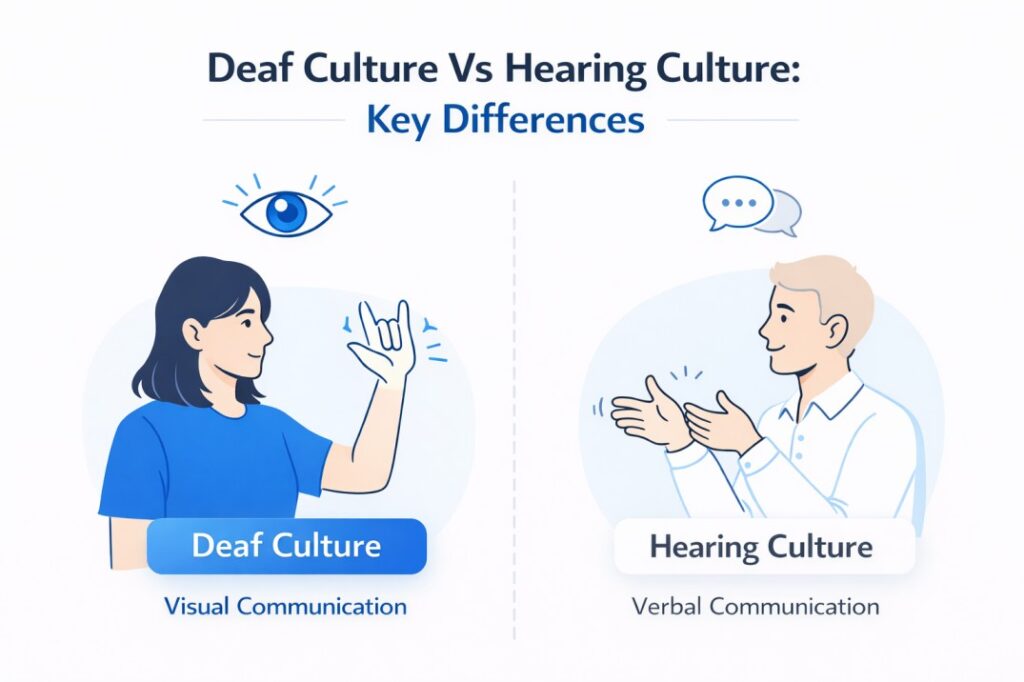
This blog post breaks down the differences between deaf culture and hearing culture in plain, accessible language. Whether you are a student learning American Sign Language, a parent of a deaf child, a healthcare provider, or simply a curious person, this guide covers everything you need to know.
What Is Deaf Culture?
Deaf culture refers to the shared language, values, norms, traditions, and social practices of people who are deaf or hard of hearing and who identify as members of the deaf community. It is not defined by audiological hearing loss alone. Instead, it is defined by a shared experience, a common language, and a sense of belonging.
In the United States, deaf culture is primarily centered around American Sign Language (ASL). Members of the deaf community view their identity as a cultural and linguistic minority – not as people with a medical impairment.
Culturally Deaf vs. Medically Deaf – What’s the Difference?
This is one of the most important distinctions to understand when exploring deaf and hearing cultures.
- Medically deaf refers to anyone with a measurable degree of hearing loss, regardless of whether they participate in deaf community life.
- Culturally deaf refers to a person who identifies with and actively participates in the deaf community, uses sign language as a primary mode of communication, and shares the community’s values and traditions.
Not every person with hearing loss is culturally deaf, and not every culturally deaf person has profound hearing loss. What defines cultural deafness is identity and community participation – not the degree of audiological impairment.
Culturally deaf people prefer to be called Deaf with a capital D. The capital D signals cultural identity rather than a medical condition. Lowercase “deaf” is typically used in a purely audiological context.
What Is the Difference Between Deaf and Deaf?
- Deaf (capital D): A person who identifies culturally with the deaf community, uses ASL or another signed language, and embraces deaf identity as a source of pride.
- deaf (lowercase d): Describes the audiological condition of not being able to hear, without implying cultural identity.
This distinction matters enormously within the deaf community. Using the wrong one can feel dismissive or uninformed to someone who identifies culturally as Deaf.
Core Values of the Deaf Community
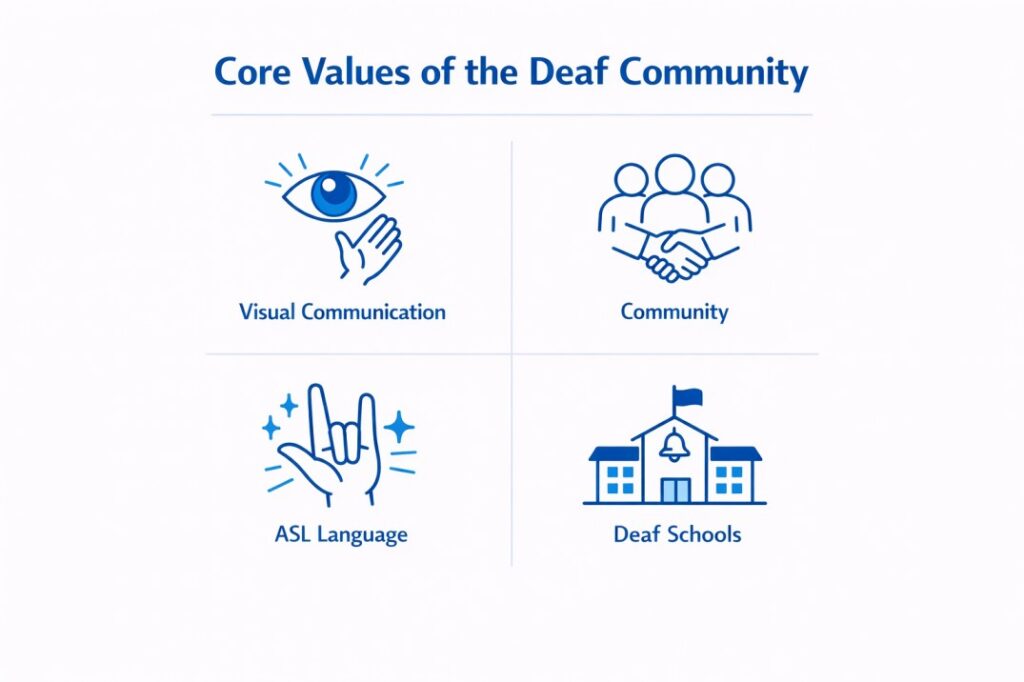
Deaf community values differ meaningfully from mainstream hearing culture values. Where hearing culture tends to prize verbal communication, individual independence, and medical solutions, the deaf community places a high value on the following:
- Visual communication as a natural, complete, and beautiful form of language
- Community solidarity – a strong sense of belonging and mutual support among deaf and hard of hearing people
- Preservation of ASL as a living language with rich grammar, literature, and humor
- Deaf schools and residential programs as cultural hubs, not merely educational institutions
- Autonomy over medical decisions – particularly regarding cochlear implants for deaf children
An Example of a Shared Value in Deaf Culture
One of the clearest examples of a shared value in deaf culture is the belief that ASL is a complete, legitimate language – not a flawed substitute for spoken English. This value shapes everything from education policy preferences to social norms in conversation. It is the foundation on which the entire cultural identity rests.
Deaf Culture Social Norms That Differ from Hearing Culture
Deaf culture has a distinct set of social norms that can feel unfamiliar to hearing people who encounter them for the first time. These are not quirks – they are logical adaptations to a visual communication world.
- Eye contact is mandatory. In hearing culture, extended eye contact can feel intense or aggressive. In deaf culture, maintaining eye contact during a conversation is required. Breaking it mid-signing is considered rude, similar to interrupting someone mid-sentence.
- Getting attention is physical, not verbal. Tapping someone on the shoulder, waving in their line of sight, or flashing the lights in a room are all standard ways to get a deaf person’s attention. Calling their name across the room is meaningless.
- Goodbyes take longer. Leaving a deaf social gathering is a gradual process involving extended farewells and continued conversation. This is known humorously within the community as the “deaf goodbye.”
- Sharing personal information is more common. Information about medical history, hearing levels, schools attended, and how someone became deaf is considered appropriate small talk – not overly personal.
- Lights stay on. When leaving a room where others are still communicating in ASL, it is polite to leave the lights on so visual communication can continue.
In contrast, hearing culture norms – speaking while walking away, covering the mouth, holding audio-only phone calls, or watching television without captions – can feel isolating or exclusionary in deaf spaces.
American Sign Language and Deaf Culture
ASL and deaf culture are inseparable. American Sign Language is not a simplified version of English. It is a fully independent language with its own grammar, syntax, facial expressions, and spatial logic. It has its own poetry, literature, humor, and storytelling traditions that cannot be directly translated into English without losing meaning.
Deaf culture and ASL together form the backbone of the American deaf community. Learning ASL is not just a communication skill for hearing people – it is an entry point into an entire cultural world.
It is also worth noting that sign languages are not universal. ASL is used in the United States and parts of Canada. British Sign Language (BSL), Australian Sign Language (Auslan), and French Sign Language (LSF) are entirely different languages. A deaf person from the UK and a deaf person from the US may not be able to communicate without an interpreter.
Read complete guide about – American Sign Language- ASL Meaning, History & How It Works
Deaf Traditions and Cultural Identity
Deaf traditions are a central part of what makes the deaf community so cohesive and vibrant. Some of the most notable include:
- Deaf schools and alumni networks. Residential schools for the deaf – like Gallaudet University in Washington, D.C. – have historically been the primary place where deaf culture is passed down from one generation to the next. These institutions are cultural landmarks, not just academic ones.
- Deaf storytelling and ASL literature. Visual storytelling, ASL poetry, and signed narratives are celebrated art forms within the community.
- Deaf humor. Much of the humor in deaf culture centers on shared experiences – navigating a hearing world, miscommunications, and the absurdities of audism (discussed below).
- Deaf sports and social clubs. Organizations like the Deaflympics and local deaf clubs provide social spaces where deaf individuals can connect, compete, and celebrate identity.
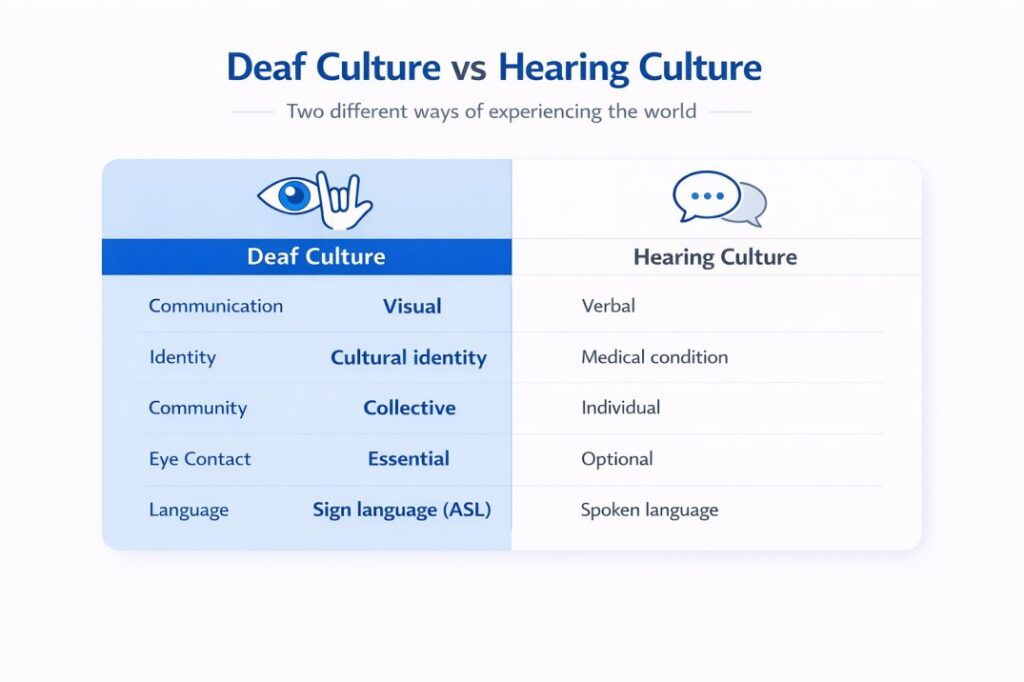
Hearing Culture vs. Deaf Culture - Key Differences
| Area | Deaf Culture | Hearing Culture |
|---|---|---|
| View of deafness | Cultural identity | Medical condition |
| Primary language | ASL or other signed language | Spoken/written language |
| Communication norm | Visual-spatial | Auditory-verbal |
| Community structure | Tight-knit, collectivist | More individualistic |
| Eye contact | Required | Context-dependent |
| Cochlear implants | Often viewed with caution | Widely celebrated |
| Preferred terminology | Deaf (capital D) | Hearing impaired or deaf |
| Education preference | Bilingual-bicultural, deaf schools | Mainstreamed, oral-focused |
What Makes Deafness Diverse?
Deafness is far from a monolithic experience. Several factors contribute to the diversity within the deaf and hard of hearing community:
- Degree of hearing loss – from mild to profound
- Age of onset – born deaf vs. becoming deaf later in life (late-deafened adults often identify differently)
- Communication method – ASL, oral communication, cued speech, or a combination
- Cultural background – race, ethnicity, and national origin all intersect with deaf identity
- Family background – approximately 90% of deaf children are born to hearing parents, which shapes early access to deaf culture
This diversity means the deaf community is not a single uniform group. There is a spectrum of identities and experiences within it.
Is Hearing Impaired the Same as Deaf?
This is a common question – and the short answer is no, they are not the same, and terminology matters.
- Deaf refers to people with significant hearing loss who often identify culturally with the deaf community.
- Hard of hearing describes people with mild to moderate hearing loss who may or may not identify with deaf culture.
- Hearing impaired is a term that many members of the deaf community find offensive because it frames deafness as a deficit or impairment rather than a cultural identity.
Most culturally deaf people and disability advocates in the United States prefer identity-first language: deaf person, not person with hearing impairment. If in doubt, the best approach is to ask the individual what terminology they prefer.
Must Read –Hard of Hearing vs. Deaf: What’s the Real Difference
Facts About Deaf Culture Most Hearing People Don't Know
- Gallaudet University in Washington, D.C. is the world’s only university designed specifically for deaf and hard of hearing students – and it is fully accredited and academically rigorous.
- ASL is the third most used language in the United States, after English and Spanish.
- Deaf culture has its own body of artistic work, including ASL poetry, deaf theater, and signed music interpretation.
- The word audism – the belief that hearing people are superior or that hearing is inherently preferable – is a concept widely understood in the deaf community but almost entirely unknown in hearing culture.
- Cochlear implants, while embraced by many late-deafened adults, are a deeply controversial topic within the culturally Deaf community when implanted in young children before they are old enough to participate in that decision.
- Many deaf people do not want to be “fixed.” They consider their deafness a defining part of who they are, not a problem to be solved.
Conclusion
The differences between deaf culture and hearing culture run much deeper than communication method. They reflect fundamentally different worldviews – about identity, language, community, and what it means to live a full life.
Hearing culture has historically viewed deafness through a medical lens: something to be treated, corrected, or overcome. Deaf culture, on the other hand, centers on pride, community, language, and self-determination. Neither view is wrong in isolation, but the hearing world’s assumptions have often come at a real cost to deaf individuals and their communities.
Key takeaways:
- Deaf culture is a real, living culture with its own language, values, norms, and traditions.
- ASL and deaf culture are deeply interconnected and inseparable in the United States.
- Terminology matters – Deaf (capital D) signals cultural identity, not just audiological status.
- Hearing impaired is not the preferred term for most culturally Deaf people.
- The deaf community is diverse, and no single experience represents all deaf people.
- Understanding the differences between deaf and hearing culture is the first step toward genuine inclusion.
Whether you are learning ASL, raising a deaf child, or simply trying to be a better ally, taking the time to understand deaf culture is one of the most respectful things you can do.
Frequently Asked Questions
What is the difference between deaf culture and hearing culture?
Deaf culture is a community built around a shared language (ASL), values, traditions, and a cultural identity rooted in deafness. Hearing culture is the dominant mainstream culture built around spoken language and auditory communication. The two differ in communication norms, community values, educational preferences, and views on deafness itself.
What does culturally Deaf mean?
Culturally Deaf (with a capital D) refers to a person who identifies as a member of the deaf community, uses sign language as their primary language, and participates in deaf cultural life. It is an identity, not just a description of hearing ability.
Is hearing impaired the same as deaf?
No. Hearing impaired is a term many in the deaf community find offensive because it frames deafness as a deficit. Deaf or hard of hearing are the preferred terms depending on the individual’s degree of hearing loss and cultural identity.
What are some examples of deaf culture social norms?
Examples include maintaining strong eye contact during signed conversations, getting someone’s attention through tapping or waving rather than calling out, keeping lights on in rooms where communication is happening, and engaging in extended farewells at social gatherings.
Why is ASL important to deaf culture?
ASL is the primary language of the American deaf community and the cornerstone of deaf cultural identity. It is a fully independent language with its own grammar, literature, humor, and storytelling traditions – not simply a visual form of English.
What makes deafness diverse within the deaf community?
Deafness is diverse because of factors like degree of hearing loss, age of onset, communication methods used, racial and ethnic background, and whether a person was raised in a deaf or hearing family. These factors all shape how individuals relate to deaf identity and the broader deaf community.