 Skip to content


Best Universities and Schools for Deaf Students in the US
Choosing the right school is always important. For Deaf and hard-of-hearing students, it can feel even higher-stakes – because the wrong environment does not just slow you down academically. It can make you feel invisible.
The good news? The US has more options than most people realize. From world-renowned deaf universities in Washington D.C. to state-run schools for the deaf from Colorado to New York, there is a path that fits your goals, your budget, and your communication needs.
- Written by: karishma Rautela
- Review by: Mahipal Dosad
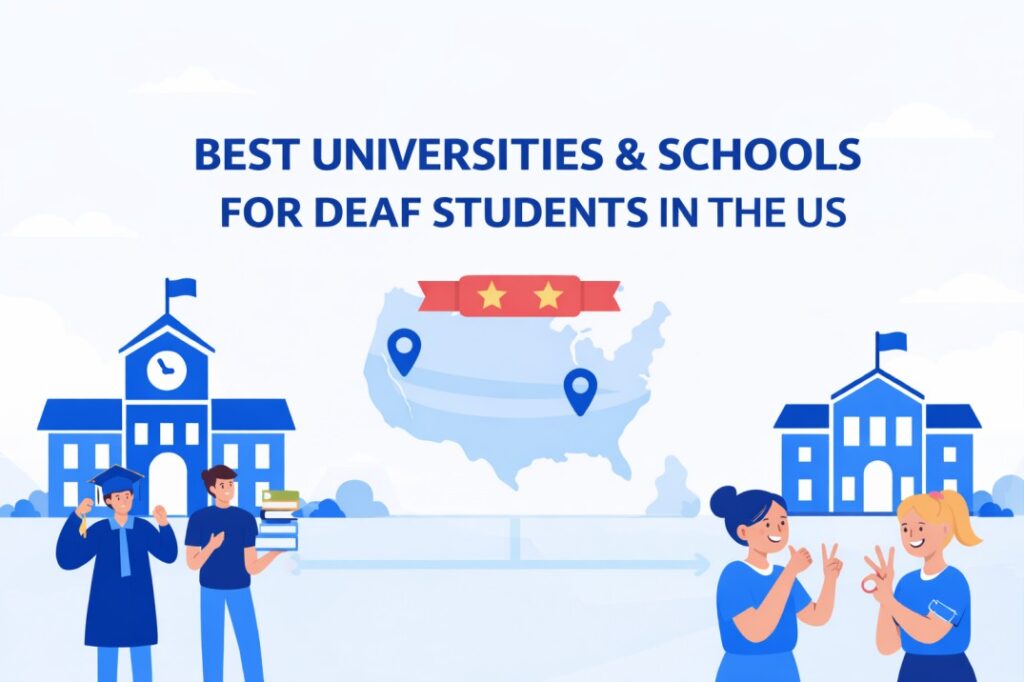
This guide covers it all – colleges for deaf students, K-12 deaf schools across America, what to look for in any program, and the tools that help deaf students succeed anywhere they study.
The Only Fully Deaf Universities in the World
Gallaudet University – Washington, D.C.
When people ask “where is the only deaf university in the world located?” – the answer is Washington, D.C. Gallaudet University is the only liberal arts university in the world designed entirely for Deaf and hard-of-hearing students, and it has been since 1864 when President Lincoln signed the bill authorizing it to grant college degrees.
Here is what makes Gallaudet stand out among all deaf universities in America:
- The entire campus operates bilingually in American Sign Language (ASL) and English.
- Students choose from 50+ undergraduate majors and graduate programs in ASL, Deaf Studies, Counseling, Linguistics, Education, and Government.
- The Office for Students with Disabilities provides CART captioning, interpreting, tutoring, and self-advocacy training
- 83% of full-time students complete an internship before graduation
- Credit transfer agreements exist with community colleges across multiple states
Gallaudet is not just a deaf university in DC – it is the cultural and academic heart of the global Deaf community. If you want full Deaf cultural immersion alongside a rigorous liberal arts education, there is no comparison.
Estimated annual cost: ~$38,000 (tuition, room, board)
National Technical Institute for the Deaf (NTID) at RIT – Rochester, New York
NTID is the world’s first and largest technical college for Deaf and hard-of-hearing students. It sits within Rochester Institute of Technology (RIT), giving students access to 90+ degree programs alongside more than 14,000 hearing peers.
- 1,100+ Deaf and hard-of-hearing students enrolled
- Instructors use ASL, fingerspelling, FM systems, CART, and spoken language
- 95% of Deaf and hard-of-hearing graduates are employed after graduation
- Alumni work at Google, Microsoft, Boeing, NASA, Disney, and federal agencies
NTID is the best choice for students interested in STEM, engineering, computing, design, or business who want both strong Deaf community support and access to one of the country’s top technology universities.
Estimated annual cost: ~$35,000
Top Colleges for Deaf Students at Mainstream Universities
CSUN – National Center on Deafness (Los Angeles, California)
California State University, Northridge (CSUN) is one of the most respected universities for deaf students outside of Gallaudet and NTID. Its National Center on Deafness (NCOD) has set a national standard for accessibility at a large public university.
CSUN offers sign language interpreting, speech-to-text transcription, note-taking, tutoring, priority registration, and leadership programs for Deaf students – across hundreds of degree programs. The CSUN Deaf Studies major is also widely respected in the field.
- Strong community for Deaf students within a large campus environment
- Los Angeles location opens doors to entertainment, media, and tech industry careers
- CSUN Deaf Studies and Deaf education programs are recognized nationally
Southwest Collegiate Institute for the Deaf (SWCID) – Big Spring, Texas
SWCID is the only self-contained community college in the US built specifically for Deaf students. Located on the Howard College campus in Texas, it offers associate degrees and vocational certifications with ASL as the primary language of instruction.
Programs include: Computer and Information Systems, Dental Lab Technology, Interpreter Training, Welding, Automotive Technology, and Visual Communications. Qualified Texas Deaf residents may be eligible for tuition exemptions – making this one of the most affordable pathways to higher education for deaf students anywhere in the country.
Other Notable Universities for Deaf Students
- University of Texas at Austin – Strong disability services, active Deaf student organizations, and access to elite graduate school pathways
- Lamar University (Texas) – Nationally recognized Deaf Studies and Deaf Education programs for students pursuing careers as educators or interpreters
- Central Washington University – Strong ASL Resource Center, flexible online/hybrid options, and a campus culture that actively includes Deaf students in everyday life
K-12 Schools for the Deaf Across the United States
The US has a well-established network of state-run residential schools for the deaf. These schools offer specialized education in ASL-rich environments, with small class sizes, Deaf role models on staff, and culturally affirming communities.
Here are some of the most recognized schools for the deaf in the US by region:
Northeast:
- Clarke School for the Deaf (New York City, NY) – one of the oldest oral deaf schools in the country
- Horace Mann School for the Deaf (Boston, MA) – the oldest public day school for the deaf in the US
- New York School for the Deaf – also known as Fanwood, serving students across New York State
- The Learning Center for the Deaf (Framingham, MA)
- School for the Deaf in New Jersey
South and Southeast:
- Arkansas School for the Deaf (Little Rock, AR)
- Tennessee School for the Deaf (Knoxville, TN) / West Tennessee School for the Deaf
- South Carolina School for the Deaf and Blind (Spartanburg, SC)
- Virginia School for the Deaf and Blind (Staunton, VA)
- Riverside School for the Deaf (Augusta, GA)
- St. Joseph’s Institute for the Deaf (St. Louis, MO)
Midwest:
- Central Institute for the Deaf (St. Louis, MO) – also a world-renowned research and education center
- Oklahoma School for the Deaf (Sulphur, OK)
- Deaf schools in Minnesota including the Minnesota State Academy for the Deaf
West:
- California School for the Deaf, Fremont (CSDF) – one of the largest residential schools in the country
- Utah Schools for the Deaf and Blind
- Deaf schools in Colorado through the Colorado School for the Deaf and Blind
- Deaf schools in Hawaii, including the Hawaii Center for the Deaf and Blind
- Washington State School for the Deaf
Texas:
- Texas School for the Deaf (Austin) – a large, well-resourced residential school serving students statewide
The Clerc Center at Gallaudet University also operates two federally funded model schools – the Kendall Demonstration Elementary School and the Model Secondary School for the Deaf – both in Washington, D.C.
To find a school for the deaf near you, contact your state’s Department of Education or visit the Conference of Educational Administrators of Schools and Programs for the Deaf (CEASD) directory.
The State of Deaf Education in America
Before diving into specific schools, it helps to understand the bigger picture.
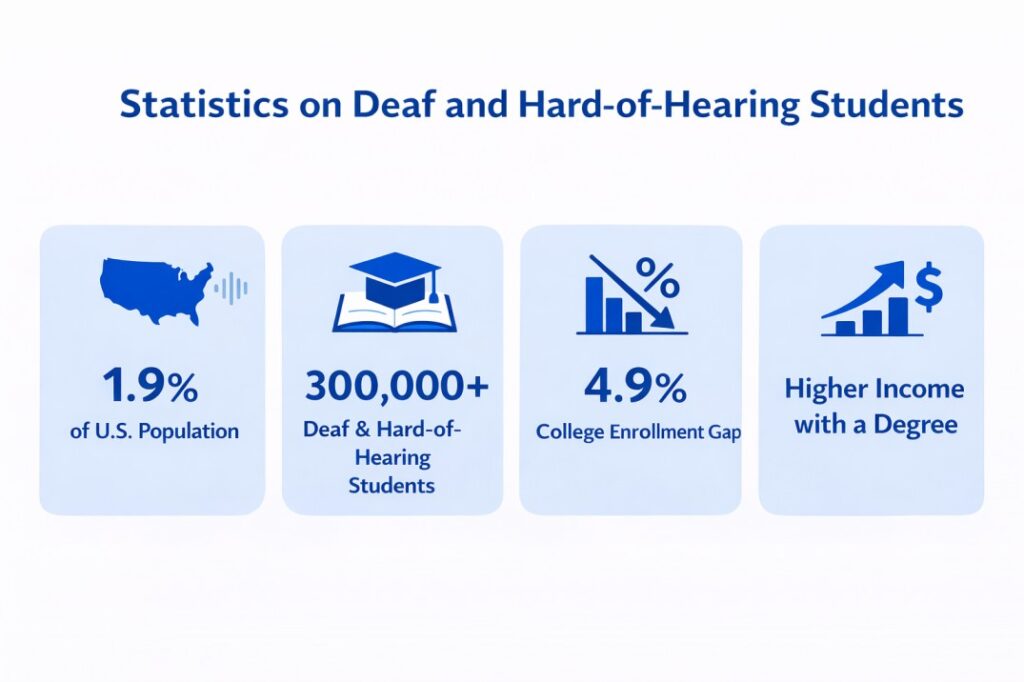
- As of 2024, roughly 1.9% of people in the United States are deaf or hard of hearing
- More than 300,000 school-age children in the US have some degree of hearing impairment
- Over 20,000 deaf and hard-of-hearing students enroll in postsecondary institutions each year
- Only 4.9% of deaf adults are currently enrolled in college, compared to 10% of hearing adults – a gap that dedicated deaf colleges and support programs are working hard to close
- Students with college degrees who are deaf earn significantly more and have higher employment rates than those without
The data points to a clear truth: access to the right educational environment changes lives. Deaf students who know their options, their rights, and the tools available to them are far more likely to succeed.
What to Look for in Any School or University for Deaf Students
Whether you are searching for a deaf university in America or evaluating your local public school, ask these questions:
- Does the school use ASL as a primary language, or only as an accommodation?
- How many certified interpreters and CART providers are on staff?
- Is there an active Deaf student community or Deaf Studies program?
- Are faculty trained in Deaf-friendly teaching practices?
- How quickly does the school respond to accommodation requests?
- Are all video and online course materials fully captioned?
- What assistive technology is available in classrooms and dorms?
The answers tell you more than any brochure. A school that is genuinely accessible does not make you fight for what you need – it has systems already in place before you arrive.
Technology That Supports Deaf Students at Any Campus
Even the best schools for the deaf and best universities for deaf students have gaps. An interpreter may not show up. A professor holds an impromptu hallway conversation. A guest lecture has no CART service arranged.
This is where real-time transcription technology becomes your personal safety net.
How iScribe Fills the Gaps
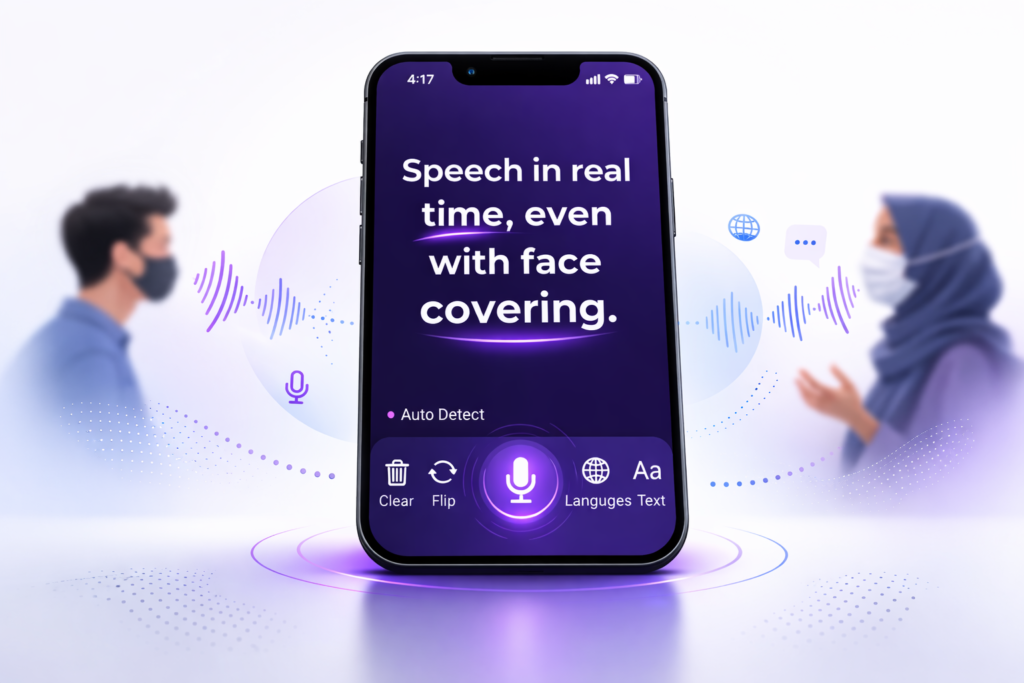
iScribe by LiveTranscribe.pro is a live speech-to-text app built specifically for Deaf and hard-of-hearing users on iPhone and iPad. It converts spoken words into readable text in real time – instantly, with no setup required.
Deaf students use iScribe to:
- Follow professors during office hours or before/after class when no interpreter is present
- Participate in study groups, labs, or fieldwork sessions
- Understand conversations at orientation events, social gatherings, or networking sessions
- Capture lectures and get AI-generated summaries and key points for later review
- Navigate internship sites, conferences, or new campus environments independently
Unlike formal accommodation requests – which can take days to process – iScribe is available the moment you open your phone. It works across all the situations that accommodation systems were never designed to handle.
You do not have to choose between your formal accommodations and tools like iScribe. They work together. Your university covers the structured, predictable parts of your day. iScribe handles everything else.
Conclusion: Finding the Right Fit
The US has more resources for Deaf and hard-of-hearing students than at any point in history. Gallaudet and NTID stand as the gold standard for deaf universities in the world. State schools for the deaf from Arkansas to Washington provide strong K-12 foundations. Programs at CSUN, UT Austin, Lamar, and dozens of other universities make higher education genuinely accessible across every field of study.
The right school is not the most famous one. It is the one where you can learn without fighting for basic access, where your identity is respected, and where the resources – both institutional and technological – put you fully in control of your education.
Start by researching what is available. Ask the hard questions. And equip yourself with every tool that helps you show up, participate, and thrive – wherever you study.
Frequently Asked Questions
Is Gallaudet the only deaf university in the world?
Yes. Gallaudet University in Washington, D.C. is the only liberal arts university in the world designed entirely for Deaf and hard-of-hearing students. NTID at RIT is the world’s largest technical college for Deaf students, but it operates within a mainstream university rather than as a standalone deaf university.
How many deaf schools are there in the US?
There are over 60 state-operated residential schools for the deaf in the United States, plus hundreds of day programs and mainstream classrooms with deaf support services. Every US state has at least one state-supported program or school for the deaf.
What states have the most resources for deaf students?
California (CSUN, CSDF Fremont), Texas (SWCID, Texas School for the Deaf), New York (NTID/RIT, Clarke School NYC), Washington D.C. (Gallaudet, Kendall School, Model Secondary School for the Deaf), and Massachusetts (Horace Mann, The Learning Center for the Deaf) are consistently among the most well-resourced states for Deaf students at all levels.
What is the difference between a deaf university and a university with deaf services?
A deaf university – like Gallaudet – is built entirely around Deaf culture and communication from the ground up. ASL is the primary language on campus. A mainstream university with deaf services provides accommodations (interpreters, CART, assistive listening) to Deaf students within a hearing-majority environment. Both can offer excellent education, but the daily experience and cultural environment are very different.
Can I study Deaf Studies online?
Yes. Several universities offer Deaf Studies degrees or certificates online, including some programs affiliated with CSUN, Lamar University, and other institutions. Online Deaf Studies degree options have expanded significantly in recent years, making the field more accessible to students who cannot relocate.
What technology helps deaf students succeed at any university?
Real-time transcription apps like iScribe by LiveTranscribe.pro convert speech to text instantly on an iPhone or iPad – giving Deaf and hard-of-hearing students immediate access to conversations in any situation, even when formal accommodations are not in place. Combined with CART captioning, ASL interpreting, FM systems, and assistive listening devices, these tools help deaf students participate fully in campus life.