 Skip to content


What Is American Sign Language? ASL Meaning, History & How It Works
Have you ever watched someone sign and wondered what they were actually saying? Those hand movements, facial expressions, and body shifts are not random gestures. They are part of a complete, living language with its own history, grammar, and culture.
- Written by: karishma Rautela
- Review by: Mahipal Dosad
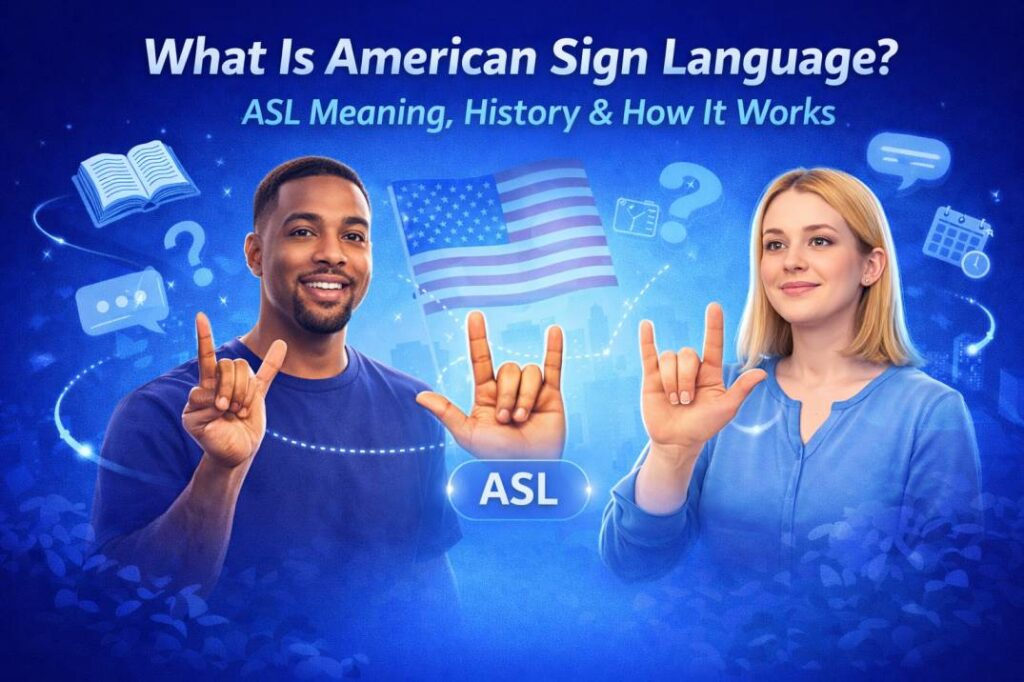
American Sign Language, or ASL, is one of the most widely used languages in the United States. Yet most people know very little about it. This guide breaks down everything – what ASL means, where it came from, how it works, who uses it, and why understanding it matters for everyone.
What Is American Sign Language?
American Sign Language is a complete natural language. It is the primary language used by many Deaf and hard-of-hearing people across the United States and parts of Canada. ASL is expressed through hand movements, facial expressions, and body posture – not through sound.
The ASL definition is important to understand clearly. It is not a simplified version of English. It is not a code layered on top of spoken words. It is an entirely independent language with its own grammar rules, sentence structure, vocabulary, and regional dialects.
Here are some key facts about what ASL is:
- ASL has all the features of a fully developed human language
- It is the primary language of an estimated 250,000 to 500,000 Deaf Americans
- When hearing users are included, several million people use ASL regularly
- ASL is widely considered the third most used language in the United States, after English and Spanish
- It is expressed through the body, not the voice – but it is no less complete or complex than any spoken language
Understanding the ASL meaning goes beyond knowing the abbreviation. It means recognizing that Deaf people have a full, rich language that is entirely their own.
Where Did ASL Come From? A Brief History
No single person invented ASL. Like all natural languages, it grew through communities over time. Knowing when ASL was created – and how – helps explain why it is so structured and expressive today.
The history of American Sign Language begins in the early 1800s. In 1817, educator Thomas Hopkins Gallaudet and Laurent Clerc, a Deaf teacher from France, co-founded the American School for the Deaf in Hartford, Connecticut.
Students at that school brought together local home sign languages from across the region and French Sign Language (known as LSF, or Langue des Signes Française). From that combination, a new language began forming naturally.
As students graduated, they spread ASL by opening schools in other states and passing the language to new communities. ASL grew the same way all living languages do – through real people meeting real communication needs every day.
Key points from the history of ASL:
- ASL originated from a mix of local home sign languages and French Sign Language in the early 1800s
- The American School for the Deaf in Hartford, Connecticut, founded in 1817, was where ASL first developed as a shared language
- ASL shares historical roots with French Sign Language but is no longer mutually intelligible with it
- ASL has evolved and grown independently for more than 200 years
- No committee, government, or single inventor created it – it emerged naturally from Deaf communities
One often-overlooked piece of ASL history: before formal schools existed, sign language was already alive in parts of America. On Martha’s Vineyard in Massachusetts, hereditary deafness was so common that both Deaf and hearing residents signed. The entire community used visual language as a normal part of daily life – and treated Deaf members as full equals.
How Does ASL Work? Grammar, Structure, and Expression
This is where most people are genuinely surprised. ASL does not follow English grammar. It has its own completely different rules.
In English, you raise your voice pitch to ask a question. In ASL, you raise your eyebrows, widen your eyes, and lean your body slightly forward. The face is not just an expression in ASL – it is grammar. Without the right facial movements, a sign can change meaning entirely or become unclear.
ASL also follows a different sentence structure. While English typically uses Subject-Verb-Object order, ASL often uses a Topic-Comment structure.
The topic of the sentence is established first, and then the comment or action follows. Spatial placement of signs, body orientation, and eye gaze all carry meaning that would otherwise be expressed through word order in English.
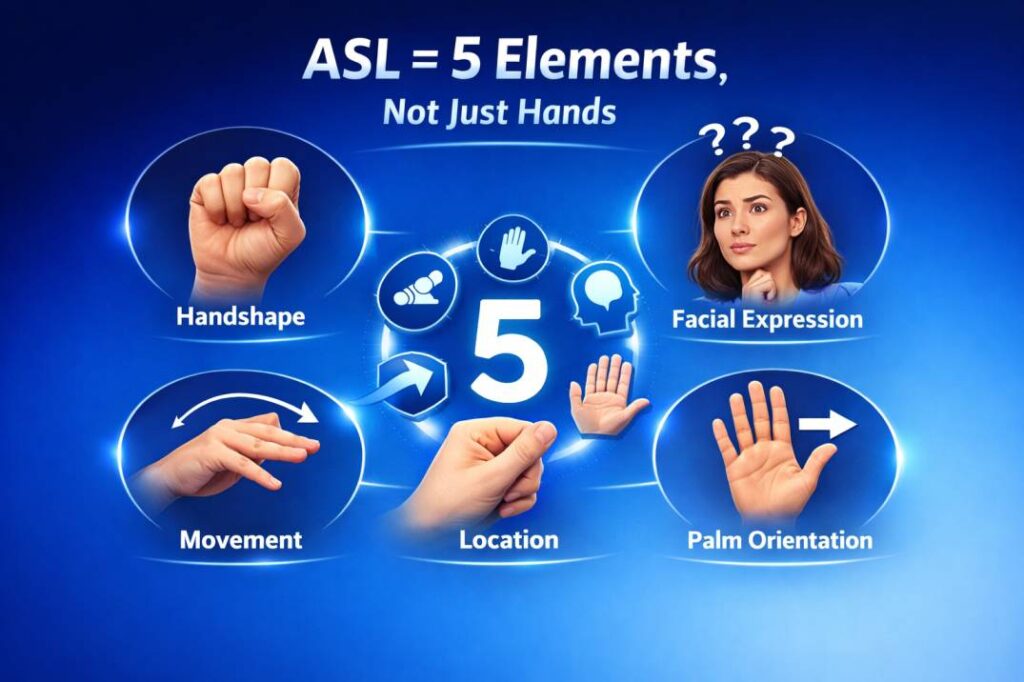
Here is how each ASL sign is built:
- Handshape – the specific configuration of the fingers and hand
- Movement – the direction, speed, and path the hand travels
- Location – where the sign is made in relation to the body
- Palm orientation – which direction the palm faces during the sign
- Facial expression – grammatically essential, not optional or decorative
Change any one of these five elements and the meaning of the sign changes. This is why ASL is described as a spatial, visual language – meaning lives in three-dimensional space, not on a flat page or in a sound wave.
Fingerspelling is also part of ASL. The American Manual Alphabet uses 22 distinct handshapes to represent the 26 letters of the English alphabet. Signers use fingerspelling for proper names, technical terms, or English words that do not have an established ASL sign. It is a borrowing tool within the language, not the foundation of it.
Just like spoken languages, ASL has regional accents and dialects. The rhythm, slang, and specific signs used in California may differ from those used in New York or Texas. A signer’s age, gender, cultural background, and which school they attended can all shape how they sign.
This freedom changes how you can use the app. Instead of rationing your minutes or worrying about hitting your limit mid-month, you can transcribe freely, whether that’s two hours of meetings in a week or an all-day conference.
Is Sign Language the Same in Every Country?
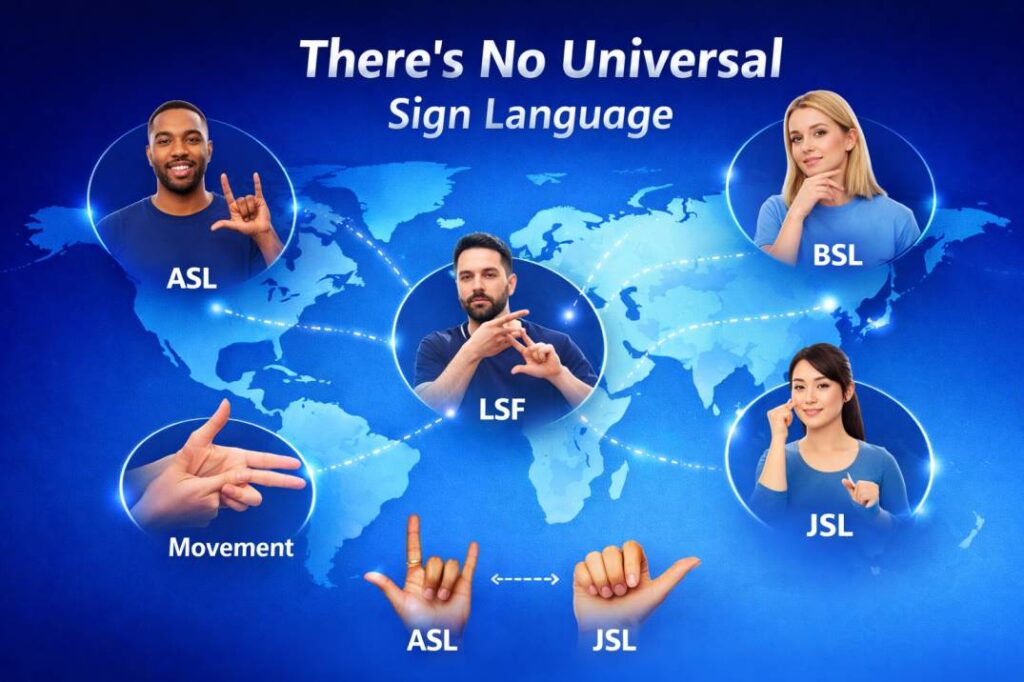
Many people assume there is one global sign language that all Deaf people share. This is one of the most common misconceptions about ASL and sign language in general.
There is no universal sign language.
Different sign languages developed in different countries and regions, shaped by local Deaf communities, educational histories, and cultures.
British Sign Language (BSL) is so different from ASL that a fluent ASL user and a fluent BSL user cannot understand each other – even though both live in primarily English-speaking countries.
Facts about sign language around the world:
- The World Federation of the Deaf recognizes more than 300 distinct sign languages globally
- Each sign language belongs to its own linguistic family and cultural community
- Some countries incorporated elements of ASL because American educators established Deaf schools abroad in the 1800s and 1900s
- Those borrowed influences evolved independently into distinct languages over time
- There have been efforts to create International Sign, a contact language used at global Deaf events – but it is not a full natural language
Within the United States, Black American Sign Language (BASL) is a recognized dialect of ASL. It developed separately during the era of school segregation, when Black Deaf students attended different institutions from white Deaf students in the American South.
BASL has its own vocabulary, grammatical features, and deep cultural significance. It is an important and growing area of recognition within the broader ASL community.
Who Uses ASL? Understanding the Deaf Community
The Deaf community is not a single, uniform group. People have different relationships with hearing loss, different communication preferences, and different cultural identities. ASL users are equally diverse.
About 48 million Americans have some degree of hearing loss. Of those, roughly 2 million are considered functionally Deaf. But ASL usage extends well beyond this group.
People who commonly use ASL include:
- Deaf individuals for whom ASL is their native, first language
- Hard-of-hearing people who use ASL in some or all communication situations
- CODAs – Children of Deaf Adults – who grow up bilingual in both ASL and English
- Hearing parents of Deaf children who learn ASL to communicate with their child
- Professional ASL interpreters who work in schools, hospitals, courts, and workplaces
- Students learning ASL as a second or foreign language in high schools and universities
- Partners, siblings, and close friends of Deaf individuals
One statistic that surprises many hearing people: approximately 9 out of 10 children born Deaf are born to hearing parents. This means most Deaf children do not grow up in homes where ASL is already present.
Many hearing parents choose to learn ASL alongside their child. Deaf peers and the broader Deaf community often play a central role in passing ASL on to the next generation.
Want to understand the real difference? Explore our full guide on Hard of Hearing vs. Deaf.
Why Early Language Learning Matters for Deaf Children
Research is consistent and clear on this point. The earlier a child is exposed to language – whether signed or spoken – the better their cognitive, social, and communication development will be. The first few years of life are the most critical window for language acquisition.
For Deaf children, delayed access to language has lasting consequences. It can affect literacy, academic performance, social confidence, and long-term communication skills. This is why early identification of hearing loss is so important.
What parents and families should know:
- Newborn hearing screening programs are now standard at nearly all U.S. hospitals
- These programs allow families to identify hearing loss before leaving the hospital
- Early identification gives families time to explore communication options during the most important developmental window
- Families who choose ASL do not need to be fluent from day one – learning together is what matters
- Connecting with Deaf adults and the Deaf community creates the language-rich environment every child needs
Hearing parents who commit to learning ASL alongside their Deaf child are giving that child one of the most powerful foundations possible – a complete first language that will shape how they think, communicate, and connect with the world.
What Brain Research Tells Us About ASL
Sign language research has changed what scientists understand about how the human brain processes language.
Studies funded by the National Institute on Deafness and Other Communication Disorders (NIDCD) have found that the same brain regions involved in spoken language are equally active during signed language.
Building complex sentences in English or in ASL activates the same neural systems. The brain does not treat signed and spoken languages differently – language is language, regardless of whether it travels through sound or through visual space.
What this research means in practice:
- Signs and gestures can be used effectively in therapy for people who lose spoken language after a brain injury or stroke
- Understanding sign language neuroscience helps researchers support Deaf children with early language development
- It opens new pathways for diagnosing and treating language impairments across diverse populations
- Emerging sign languages – developing in isolated communities with no outside influence – give researchers a window into what is universal about human language
This research confirms something the Deaf community has always known: ASL is a real, fully functioning language in every sense – including in the brain.
How Live Transcription Supports the Deaf Community
Live transcription technology converts spoken words into text in real time. For Deaf and hard-of-hearing individuals, this means following a conversation as it happens – without waiting for an interpreter, without straining to read lips, and without missing what was said.
Apps like iScribe, are built specifically for this purpose. The app displays transcribed text on iPhone and iPad as words are spoken. It works offline for use during travel, in remote areas, or in buildings with limited connectivity.
AI-generated summaries help users catch up on longer conversations, and customizable font sizes make the display easy to read in any setting. Ways live transcription helps Deaf and hard-of-hearing users every day:
- Following a doctor’s explanation in real time without a scheduled interpreter present
- Staying fully engaged in fast-moving workplace meetings and conversations
- Participating in social gatherings without feeling left out of group discussions
- Accessing information during travel when connectivity is limited
- Using it across more than 100 languages depending on the situation
Live transcription does not replace ASL or professional interpreters. It fills gaps. A fluent ASL signer might use a transcription app at an unplanned medical visit, in a workplace meeting with hearing colleagues, or in any situation where a trained interpreter is not available. Communication independence means having more options – not fewer.
Conclusion
American Sign Language is one of the most sophisticated and culturally meaningful languages in the world. It carries more than 200 years of history, a grammar system as complete and complex as any spoken language, and a community of millions of users whose identities, relationships, and daily lives are shaped by it.
Understanding ASL – even at a basic level – makes you a more informed communicator, a stronger ally to the Deaf community, and a more empathetic person overall.
Key takeaways from this guide:
- ASL is a complete, independent language – not a version of English or a simple set of gestures
- It originated in the early 1800s from a mix of local sign languages and French Sign Language
- ASL grammar uses handshape, movement, location, palm orientation, and facial expression
- Sign language is not universal – every country has developed its own
- Early language exposure is critical for Deaf children’s development and well-being
- Brain research confirms that signed and spoken languages use the same neural systems
- Live transcription tools like iScribe complement ASL by filling real-world communication gaps every day
Whether you are a parent, a student, a healthcare worker, or simply someone who wants to understand the world better – learning about ASL is a meaningful place to start.
Frequently Asked Questions
What does ASL stand for?
ASL stands for American Sign Language. It is the primary sign language used by Deaf and hard-of-hearing individuals in the United States and parts of Canada.
Is ASL a real language?
Yes. ASL is a fully developed natural human language with its own grammar, syntax, and vocabulary. Linguists classify it as a complete language – not a code or simplified system based on English.
Is sign language the same in every country?
No. Sign language is not universal. Different countries use entirely different sign languages. British Sign Language (BSL), for example, is completely different from ASL despite both countries using English as their primary spoken language.
Who invented ASL?
No single person invented ASL. It emerged naturally in the early 1800s from a combination of local home sign languages and French Sign Language, primarily through the founding of the American School for the Deaf in Hartford, Connecticut in 1817.
How long does it take to learn ASL?
Like any language, reaching fluency in ASL takes consistent time and practice. Many learners achieve conversational ability within one to two years of regular study. Immersion in the Deaf community significantly accelerates the learning process.
Can hearing people learn and use ASL?
Absolutely. Millions of hearing people use ASL – including parents of Deaf children, professional interpreters, students, and family members. Hearing people who learn ASL directly reduce communication barriers and contribute to a more accessible world for the Deaf community.